

Fans Give Their Thoughts on How to Improve the Next-Gen Car

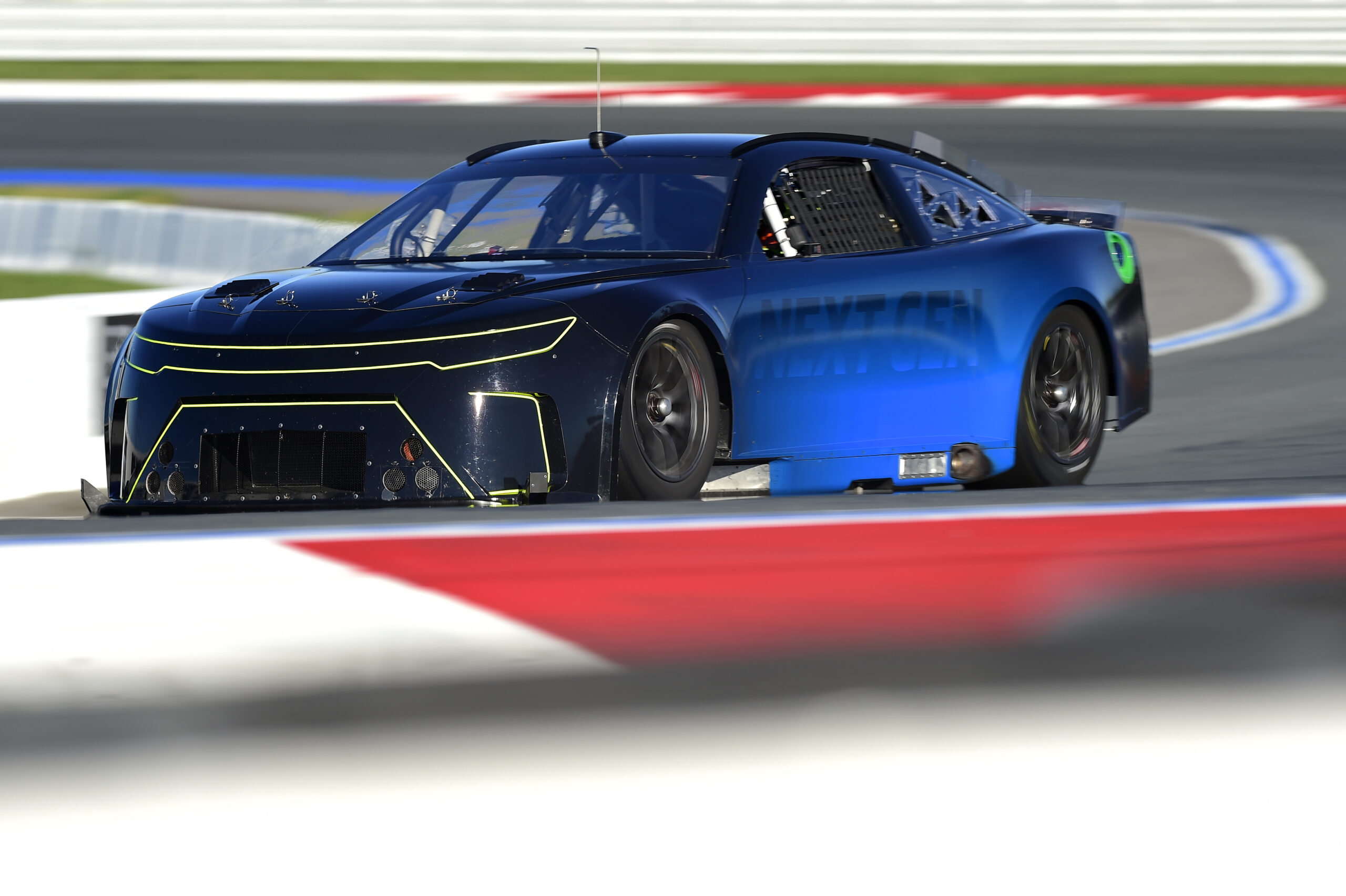
CONCORD, NORTH CAROLINA - NOVEMBER 16: Kurt Busch drives the NASCAR Next Gen car during the NASCAR Cup Series test at Charlotte Motor Speedway on November 16, 2020 in Concord, North Carolina. (Photo by Jared C. Tilton/Getty Images)
Yesterday, we took a look at 7 BOLD Ideas to improve the Next-Gen car. The Daily Downforce readers responded to it with their own ideas for how to fix the Next-Gen car, and, did they come up with some interesting ideas.

Last week, we took a look at 7 BOLD Ideas to improve the Next-Gen car. The Daily Downforce readers responded to it with their own ideas for how to fix the Next-Gen car, and, did they come up with some interesting ideas?

Thoughts on improving the Next-Gen car mainly talked about horsepower and tires, with a large emphasis on improving the product on short tracks and road courses. These are probably the most common ways that people give to improve the Next-Gen car. The racing product on short tracks and road courses have been a source of contention amongst many in the NASCAR fanbase.

Others just wanted to get rid of the Next-Gen car entirely. Some suggested going back to previous generations and others just wanted to start from scratch.

Others had more unique ideas to improve it. Whether or not these ideas are realistic or not is dependent on the idea, and some put these ideas in a lump with the more common ideas.

Change Horsepower and tires

Betwee2Busch’s wants a narrower tire and more horsepower amongst other things. Notably enough for him, he does not want to see them touch the body at all.

Lugnut wants more horsepower, but he has a unique plan for the tire situation.

I think Wes Weekly is asking for 550 horsepower and the cars to be bottoming out in every turn. Oh….wait a minute

Robbie Manes wants NASCAR to make a couple of additional changes while also increasing horsepower.

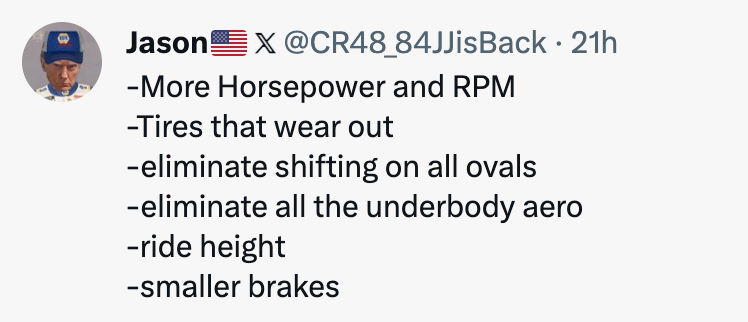
Jason wants NASCAR to make a plethora of changes to the car.
Fryguy wants to groove the tires in addition to increasing the horsepower.

RJ Ward says that the easiest way to get more horsepower is to get rid of the tapered spacer on road courses and short tracks.

Austen Stewart says “mo powa babeh”

Get Rid of the Car Entirely

Mike Holloway wants to completely start from scratch.

AP wants them to go back to the Gen-6 car, but keep it at 900 horsepower.

Kaleb L wants NASCAR to either go back to Gen-6 or go to the Xfinity cars in the Cup Series.

Derek wants to move the Xfinity cars up to Cup.

Joe Benoit wants to go back to the very specific year of 2012.

It’s safe to say that Rocket is not a fan of the car.

Unique Ideas

CARS Tour bodies on a NASCAR stock car?

Tyler wants them to just duplicate Garage 56. What types of things from Garage 56 will NASCAR take to the Next Gen cars for the future?

Thomas Neddo wants to see NASCAR do away with the spec part of the car.

Chris Cringel wants there to be less SMT data available to the teams to allow for more lap time variability.

Nelsonator762 says that the cars are too much in tire, aero, and size.

Imagine grooved tires like the old Formula One days.

The fans had a plethora of different ideas to improve the current state of the Next-Gen car. Which of these ideas can or will actually happen? One thing is for sure, change is probably coming at some point for the Next-Gen car.

Share this:

MADISON, ILLINOIS - JUNE 01: Denny Hamlin, driver of the #11 Yahoo! Toyota, and crew chief Christopher Gabehart talk on the grid during qualifying for the NASCAR Cup Series Enjoy Illinois 300 at WWT Raceway on June 01, 2024 in Madison, Illinois. (Photo by Logan Riely/Getty Images)

JGR Lawsuit: What Confidential Information Was Allegedly Taken?

What’s Happening?

Joe Gibbs Racing alleged that former competition director Chris Gabehart took a wide range of confidential team information regarding competitive performance data, engineering processes, financial records, and internal personnel details. But what exactly do the documents say was taken?

  • Performance, payroll, and financial data stored on personal devices: The lawsuit claims that numerous internal photos were saved to Gabehart’s personal phone and Google Photos account, which JGR says were not approved for confidential storage and were accessible to third parties, including his spouse. These images allegedly included post-race audits for the entire 2025 season, detailed team payroll information with contracts and compensation structures, tools for projecting employee pay, driver salaries for multiple seasons, sponsor and partner revenue figures, pit crew analytics, and tire performance analyses.
  • Extensive race analytics and proprietary setup files: Within the “Spire” folder, JGR says investigators found deeply technical documents tied to competitive performance. This allegedly included 140+ pages of post-race data analysis from a 2025 Las Vegas event detailing what metrics the team measures and how it measures them, as well as more than 20 “eLap” files generated by proprietary software. These reports incorporate inputs from hundreds of employees, historical databases, and simulation work to determine optimal racecar setups, which means it effectively represents the culmination of years of institutional knowledge.
  • Driver feedback systems and engineering intelligence: The complaint also references internal post-race debrief surveys completed by drivers after each event, which document both subjective feedback and structured data collection. Additional documents allegedly covered proprietary engine output information and recommended gear-shift points, along with photos of racecar diffuser skirts showing damage after a 2025 race.
  • Tire strategy, logistics, and fuel-modeling methods: Several documents reportedly describe how JGR selects, manages, and cycles tires during races. Others detail initiatives for transporting equipment and racecars more efficiently while improving communication among engineers. The filing also mentions proprietary fuel-mileage estimation models for both JGR drivers and competitors, including methods used to refine accuracy during races.
  • Compensation records and competitive performance comparisons: Investigators allegedly found spreadsheets listing base salaries and bonus structures for key team personnel, along with documents comparing a JGR driver’s performance at a specific race to that of a Spire driver using JGR’s proprietary analytical tools. JGR argues that both categories of information are highly sensitive.
  • Alleged recruitment of JGR personnel: In addition to the data itself, Gabehart allegedly attempted to recruit JGR employees to join him at Spire. The complaint states that he had access to payroll information for all drivers and employees, which JGR suggests could have supported those efforts. According to the filing, at least one employee has already left JGR for Spire.

What JGR Is Seeking From the Lawsuit

JGR states it is entitled to damages believed to exceed $8 million, potentially subject to enhancement, along with attorneys’ fees. The organization is also seeking multiple forms of relief, expected to exceed that amount, as well as a cease-and-desist order to prevent any use or disclosure of what it describes as trade secrets.

You can learn more about the lawsuit itself, the circumstances surrounding Gabehart’s departure, and the broader allegations in the article linked below

NASCAR isn’t nerdy enough…

NASCAR isn’t nerdy enough. Not in a cringe way, not in a gimmicky way, but in a way that could quietly and organically grow the sport. After a Daytona weekend filled with spectacle and nostalgia, DJ Yee believes there’s a bigger opportunity sitting right in front of NASCAR, one that doesn’t change the racing at all but could completely change how fans engage with it.

  • Is NASCAR leaving storytelling power on the table by hiding deeper data?
  • Could advanced stats create year-round narratives the sport desperately needs?
  • Why do sports like baseball thrive on analytics while NASCAR stays surface-level?
  • And what if fans could choose to dive deeper without it affecting casual viewers at all?

Other leagues have turned analytics into conversation fuel. In baseball, stars like Aaron Judge and Shohei Ohtani aren’t loud personalities, but advanced metrics tell their story anyway. NASCAR, meanwhile, has mountains of telemetry data but shares very little of it in a meaningful way. Throttle traces, brake usage, steering inputs, tire wear models, fuel efficiency ratings, clean air percentages, and even a “positions above replacement” type metric, the possibilities are endless. None of it would intrude on the racing. Casual fans could ignore it. But hardcore fans, creators, and analysts would suddenly have tools to build deeper narratives around drivers and performance.

Watch Also

NASCAR Needs To Keep Doing This!

For the first time in a while, it feels like NASCAR fans see a bigger light at the end of the tunnel. The start of 2026 has brought real optimism, from improved racing to sharper marketing, and even an 11 percent bump for the Daytona 500 to 7.5 million viewers. After a rough couple of seasons, that kind of stability matters. The question now is simple, is this momentum real or just a honeymoon phase?

  • Is NASCAR finally leaning into what makes the sport fun instead of forcing gimmicks?
  • Are driver personality promos building future stars the right way?
  • Does embracing the sport’s identity matter more than chasing casual viewers?
  • And most importantly, can NASCAR stay consistent long enough for growth to stick?

There’s been a noticeable shift. The marketing feels more modern without feeling fake. Broadcasts are embracing energy and meme culture without losing authenticity. Social media efforts are spotlighting drivers and personalities in ways that echo how legends like Dale Earnhardt Jr., Jeff Gordon, and Tony Stewart once drew fans in. NASCAR’s identity has always been edge, personality, and grassroots simplicity, and recent changes feel closer to that core. But none of it matters without patience. Jaret believes the foundation may be stronger right now, but consistency will decide whether this is a spark or a true turning point.

Watch Also