The Complete 2025 NASCAR Cup Series Full-Time Driver Roster
What’s Happening? The 2025 NASCAR Cup Series roster is slowly coming together. Many teams made major moves as early as May…
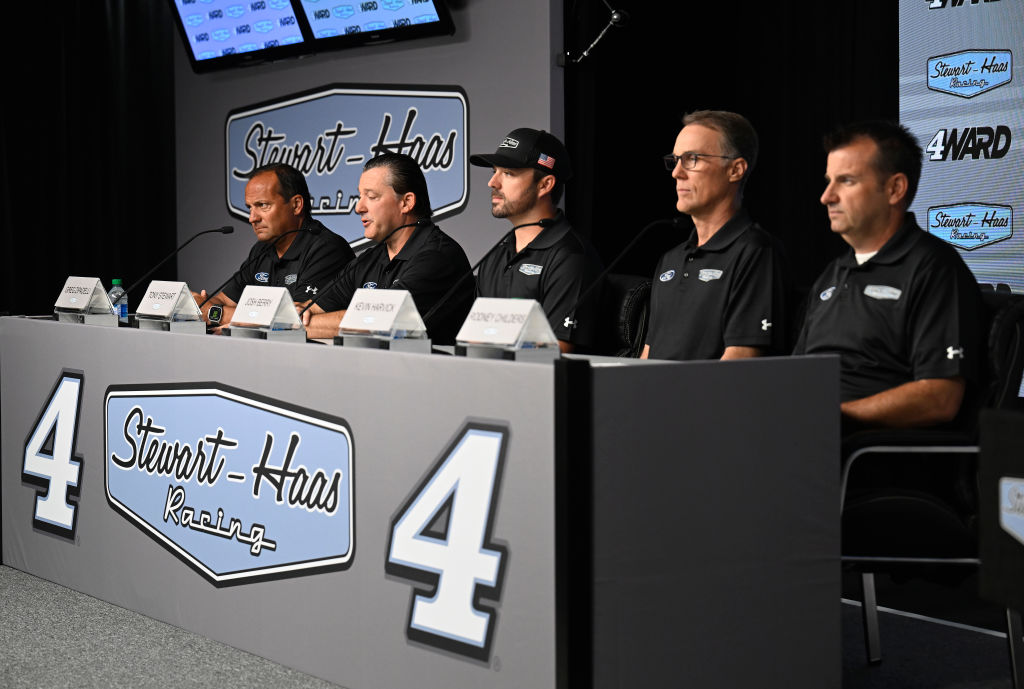


NASCAR Silly Season tends to create a domino effect of driver moves, promotions, demotions, and expansions. This year, one storyline, the closure of Stewart-Haas Racing, single-handedly affected several teams and drivers’ plans for 2025. So, here’s the domino effect of Stewart-Haas Racing’s closure on NASCAR Silly Season.
What’s Happening? The 2025 NASCAR Cup Series roster is slowly coming together. Many teams made major moves as early as May…
When SHR first announced its closure in May, most fans were interested in how their Charters would be distributed. The sale of these Charters would allow established and up-and-coming teams the opportunity to add a third or potentially fourth car to their lineup.
However, one aspect slightly overlooked due to the importance of these Charters is, of course, the demolition of SHR’s Cup Series lineup. We’ll start with the driver moves in the Cup Series, as these were the least consequential dominos overall.
For example, Ryan Preece did not necessarily displace any driver; rather, he took an already expanding spot with RFK Racing. Chase Briscoe replaced a driver. However, that driver, Martin Truex Jr, was more than likely going to retire at year’s end. This move is similar to what Noah Gragson did. His domino effect on free agency resulted in Gragson taking over Michael McDowell’s spot at Front-Row Motorsports. However, McDowell was already heading to Spire Motorsports, a team we will return to momentarily.
In fact, the only driver who had a decent domino effect was Josh Berry’s free agency. After driving the No.4 in 2024, Berry announced he would head to Wood Brothers Racing and the No. 21 in 2025. The resulting domino effect saw Harrison Burton out at WBR. Burton landed on his feet in the Xfinity series, with AM Racing replacing the released Hailie Deegan.
What’s Happening? The 23XI Racing and Front Row Motorsports lawsuit will continue for some time. However, many developments will occur along…
Of the three Charters sold from SHR, one has a long domino effect on driver moves, while the other two are part of a long, unwinding storyline that could flow into next season.
First, Trackhouse Racing purchased a charter to expand to three teams in the NASCAR Cup series. In doing so, they called up Shane Van Gisbergen from Kaulig Racing’s Xfinity Series program. Trackhouse also released Zane Smith from his developmental deal, where he was racing for Spire Motorsports, which inadvertently could have pulled Michael McDowell out of his FRM ride for Noah Gragson.
However, the dominoes from this purchase continue to fall in the Xfinity Series, where Kaulig Racing signed Daniel Dye to replace Shane Van Gisbergen in the Xfinity Series. Dye’s move left an open ride in the Truck Series that may have been filled this week by Connor Mosack.
At McAnally-Hilgemann Racing, Dye drove the No. 43. However, MHR already announced that Mosack would drive the new No. 81, retaining Dye’s Crew Chief. This perhaps continues the legacy of the No. 43 under a new number. Maybe this is where the domino effect stops for this charter.
The other two Charters were agreed to be purchased by Front Row Motorsports and 23XI Racing. However, both these Charters are entirely up in the air as neither the purchase nor the transfer has gone through. This is due to an ongoing antitrust lawsuit between the two teams and NASCAR, in which the teams could lose their Charters, including these two SHR charters. NASCAR recently claimed they will not transfer these Charters to the teams. However, a preliminary injunction could change this.
Prior to the lawsuit, both teams planned their expansions, leading to preparations for both teams to field a third car in 2025. This led to the hiring of Riley Herbst at 23XI and perhaps a return for Zane Smith to FRM in 2025. Herbst, much like Smith, was already a free agent thanks to the domino effect of SHR’s closure.
What’s Happening? The 2025 NASCAR Xfinity Series season isn’t here quite yet. However, multiple drivers and teams have confirmed their plans…
When SHR initially announced its closure in May, most expected the team to sell all four Charters. However, co-owner Gene Haas announced he would hold onto a Charter and the team’s two-car Xfinity Series program for the future. This new team, known as the Haas Factory Team, would entirely reset the SHR Xfinity lineups for 2025.
The first confirmed move was that Cole Custer would move from the team‘s No. 00 Xfinity car to their single-car Cup Series team in 2025. Furthermore, the HFT announced Riley Herbst would not return to the Xfinity Series team in 2025, making him a free agent for 23XI.
The domino effect here is that Sheldon Creed of Joe Gibbs Racing and Sam Mayer of JR Motorsports would leave their rides for the two HFT Xfinity cars. These moves gave two top prospects the opportunity to race in the Xfinity Series in 2025. JGR signed top prospect William Sawalich to drive the No. 18 in 2025. JRM, without Mayer, finally had room for top prospect Carson Kvapil to drive the No. 1 next season.
While some of these moves would have happened either way, these are just small details. They show how one major move can affect the entirety of NASCAR Silly Season. Furthermore, the domino effect of SHR’s closure will continue after Silly Season is done and into the future.
What do you think about this? Let us know your opinions on Discord or X, and don’t forget that you can also follow us on Instagram, Facebook, and YouTube.