
What Exactly Is NASCAR Pit Strategy?

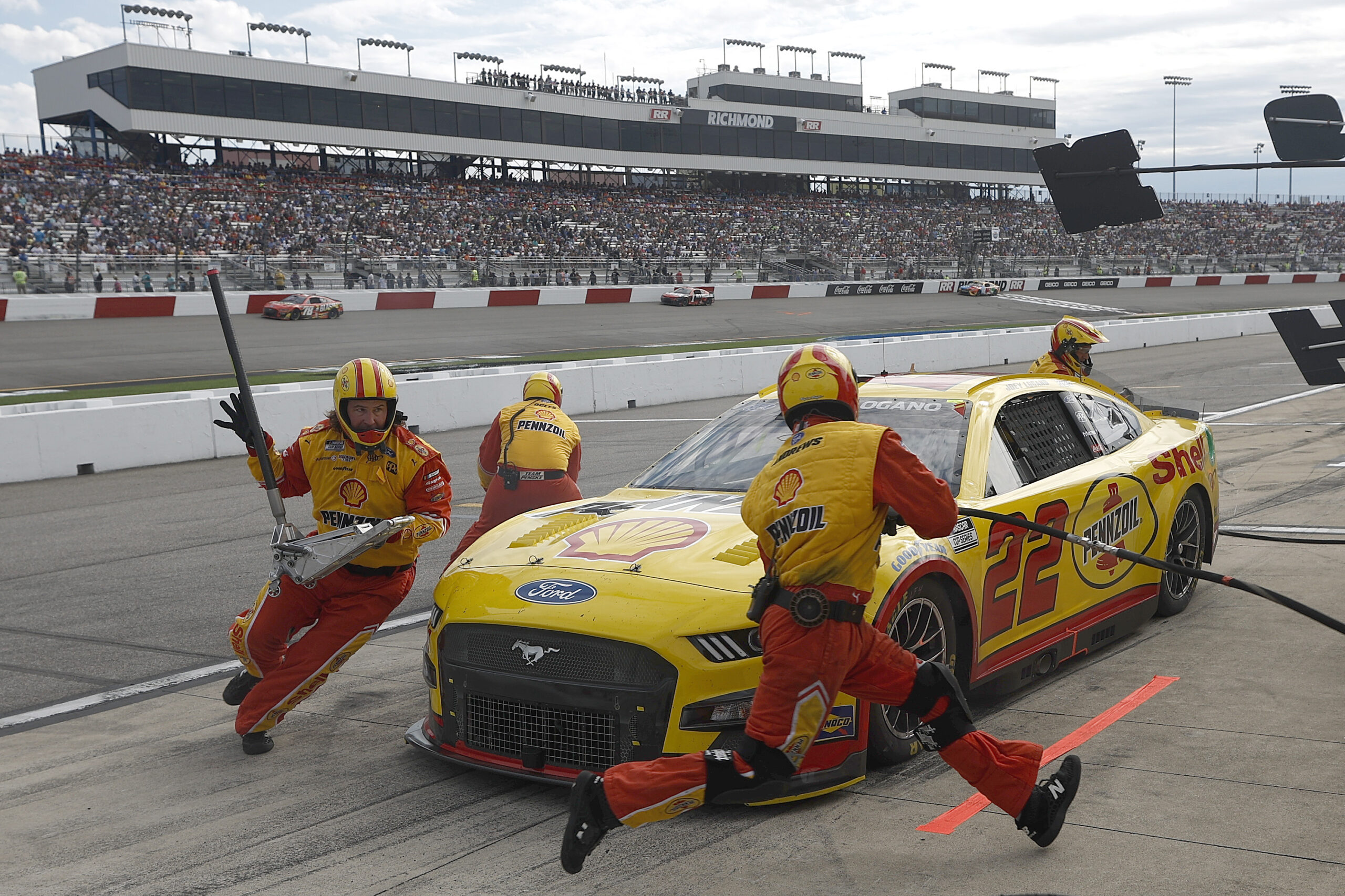
RICHMOND, VIRGINIA - AUGUST 14: Joey Logano, driver of the #22 Shell Pennzoil Ford, pits during the NASCAR Cup Series Federated Auto Parts 400 at Richmond Raceway on August 14, 2022 in Richmond, Virginia. (Photo by Chris Graythen/Getty Images)
A breakdown of pit strategy and all its components, from tire changes to common costly mistakes

Perhaps one of the most integral parts of any race team’s weekend success is NASCAR pit strategy. Every race, NASCAR drivers enter the pits to put on fresh rubber or fuel up. Typically, this process takes place during the stage breaks and usually once roughly halfway through the final stage of the race. However, sometimes teams feel the itch to roll the dice. Maybe it’s because they hadn’t won in a while. Maybe it’s because they’re thirsting for another victory to add to their yearly statistics. And sometimes, it’s just to try something different to gain valuable track position. Or, on the flip side of that, it’s to gain a handful of stage points.

Regardless of the reasoning, pit strategy wins (and loses) races. So, that begs the question: What is pit strategy? Let’s talk about it in all its various components.

Fueling

Fuel strategy races are hardly a thing anymore. But back in the day, knowing how to conserve fuel or short-pitting could sometimes change the game in the latter stages of a race. Dale Jr. broke a long winless drought (the second longest of his career) in 2008 with a fuel mileage win at Michigan.

And then, on the side of heartbreak, in 2011 amidst the longest win of his career that wouldn’t be snapped until 4 years after the 2008 win at Michigan, Dale Jr. came up just a hundred yards short of victory in the Coca-Cola 600. What was Dale Jr.’s (and Junior Nation’s) most devastating losses ended up being a massive win for none other than the closer himself, Kevin Harvick.

With stage cautions, not to mention fuel-injecting engines, it’s not as common for drivers to just run out of gas before the completion of a race. But it does happen, on occasion. Sometimes, the gas man doesn’t get the entire fuel cell full, which can lead to the driver running out of fuel in the closing laps of a given race. This begs the question: What determines how long a car remains in its pit stall fueling up? Well, typically, that depends on the tire strategy, which we’ll discuss in greater detail in the next session.

Basically, the driver’s cue to go is once it is let off the jack. So, depending on whether the driver is taking only two fresh tires or four is typically how much fuel the car is getting. So, a car getting four fresh tires is taking in a lot more fuel than a car getting only two.

If the crew chief’s calculator is correct, the driver should be fine. But sometimes, there are mistakes in the math, which leads to drivers running out of fuel and, ultimately, losing races.

To Change 4 Tires or 2?

The biggest wildcard when it comes to pit strategy is the tire strategy. This is because, above all else, the difference between two and four fresh tires is illustrated best with the track speed of the car. However, deciding what the ideal tire strategy should be is largely dependent on the rubber compound Goodyear brings to each individual race as well as the track condition. The most memorable tire issue from 2023 was when the NASCAR Cup Series returned to North Wilkesboro Speedway for the All-Star race.

For the first time in that track’s history, Goodyear brought a wet-weather-purpose tire in the event that rain caused track conditions to become a little damp. These tires were made of a harder rubber compound than NASCAR’s traditional slicks and therefore could handle more abuse. When teams arrived in Wilkes County, they knew that the potential for tire wear was pretty high considering the aged, worn-out surface of the track’s asphalt. This in tandem with the rubber compound of the slicks made the average green flag run the rubber could withstand settle around 17 laps.

On the flip side of that, a track that has been recently repaved is not as hard on the Goodyear rubber, and therefore tires show less wear and can last quite a bit longer. That is not to say that speed does not get rubbed off, of course, it does. And that’s where the strategy comes into play. Depending on when a driver and crew chief decide to pit, this can either help them or hurt them in terms of long-term race strategy.

Fresher tires almost always run faster than scuffs or older tires. So, the earlier a driver pits, the more speed they’ll pick up on the drivers who, at that point, have stayed out. Meanwhile, drivers who stay out for track position or in hopes that a caution will help them get caught back up will lose time to those who recently pitted but will be able to last longer on the next cycle.

The decision to take 2 tires, 4 tires, or no tires could deeply affect the outcome of a given driver’s race, for better or worse.

Pitting As A Caution Comes Out

Pitting as a caution is coming out is a slippery slope that could greatly help a driver out but it could also put them so far behind that they either spend the whole race trying to make that ground back up or they never truly recover. This video by Joe Gibbs Racing’s YouTube channel explains this issue in great detail:

Basically, if a driver is on pit road and a caution comes out, their position on the track will be determined by where they come out of pit road in relation to the leader. If the driver goes a lap down in the process, then they are either stuck a lap down or, if all the lead lap drivers pit, they can take the waive around but will still have to restart the race in the back of the pack, regardless of where they were running when they initially entered pit road. If the leader passes the start/finish line before the driver can exit pit road, the driver is then trapped a lap down. On the opposite side of that, if the driver is able to escape pit road before the pace car makes it to the start/finish line, the driver will then get to leapfrog all the other drivers who pit during the caution and will then be in better position to compete for a solid finish.

A mistake here can really hurt a driver’s chances of winning or even gaining a decent finish. It can put them behind and playing catchup all race.

Common Penalties and Mistakes

If getting trapped a lap down and mired back in traffic due to a poorly-time caution wasn’t enough to ruin a driver’s day, costly mistakes on pit road that result in penalties could potentially be enough to end it. Easily the most common of these penalties is a pass-through penalty as a result of speeding on pit road. Pit road has a set speed in which drivers must maintain through all electrically scored sectors. Typically, this speed is somewhere between 30 and 60 miles per hour but each track is different. This is why is it so important that the driver’s digital dash and lighting system is accurately set to that weekend’s pit road speed limit.

If a driver is caught by radar speeding on pit road, they will be forced to do a drive-through penalty which could result in the driver being laps down (in the case of short tracks like Bristol or Martinsville), mired back in traffic, or, worse, isolated with no sniff of the draft on superspeedway style tracks (like Daytona, Talladega, and Atlanta).

Another common penalty in the lower series, such as Xfinity or Trucks, is a loose lug nut penalty. This isn’t really as big of a problem anymore in Cup as they only have a single lug on all four tires but in Xfinity and Trucks, there are still 5 and all need to be tightened. This is due A.) to safety concerns, and B.) to avoid a needless caution that sees someone’s tire fly off their car while they’re at maximum speed. This typically results in a monetary fine for the driver, the crew chief, and/or the team owner and can sometimes yield a points penalty.

Then there are the penalties for a team having too many crew members over the wall, pitting outside the box, or equipment (and tires) leaving the pit box. Typically, the penalty for these infractions is to simply restart at the tail end of the longest line, with no monetary fine necessary.

Conclusion

Pit strategy directly affects the flow and outcome of any given race and is an integral part of a team’s race day plan. So, Daily Downforce readers, what are your questions in regard to pit strategy? Do you miss the days of intense fuel strategy races or do you like the flow the current stage racing gives us? Let us know! Keep it right here at DailyDownforce.com for all your latest off-season NASCAR news stories and fan discussion topics!

Share this:

COTA Groovy Gauge Presented by Lectric eBikes

Three races, three wins, and three straight celebrations with Michael Jordan. History was made at Circuit of the Americas as Tyler Reddick opened the season with an unprecedented three straight victories, holding off Shane van Gisbergen in the Texas heat while chaos and strategy shuffled the field behind them. Here’s how it scored on the Groovy Gauge, powered by Lectric eBikes.

Groovy Gauge Score: 65%

  • Eric believes what makes this race memorable is the history, three straight wins to start a season has never happened in 75-plus years, especially in the parity-driven Next Gen era, and that doing it with 23XI Racing makes it feel even more impressive.
  • Eric thinks Reddick beating van Gisbergen straight up matters, snapping SVG’s road course streak and doing it at a track where both are elite, raising the legitimacy of the run.
  • Eric believes stage one and two dragged because of predictable strategy flips, with drivers sacrificing points for track position, making the race feel like it truly began in stage three, with the first two stages being “fillers.”
  • Eric thinks the final 45 laps delivered solid intensity, with Blaney pressuring early, SVG hanging tough, and Connor Zilisch flashing high speed before late race contact derailed a potential breakout. He says just Zilisch’s climb through the field was worth watching.

2026 Groovy Gauge Score Tracker

RaceScoreSource
Clash at Bowman Gray50%Watch HERE
Daytona 50085%Watch HERE
Atlanta90%Watch HERE
COTA65%Watch HERE

The Biggest Losers from the NASCAR Race Weekend at COTA

What’s Happening?

After two wildcards to kick off the 2026 season, NASCAR headed to Circuit of the Americas (COTA) for round 3 on the year. The big headline heading into this weekend was whether or not Tyler Reddick could become the first driver in NASCAR history to win three straight races to start a campaign. Three times before, drivers have won the first two races of the year. Now Reddick, fresh off the heels of a Daytona 500 win and a win at Atlanta makes history as the only driver to go three for three.

The No. 45 23XI team is certainly on a roll with a 70-point points lead. However, not everyone had a weekend to remember. Here are the biggest losers of the 2026 NASCAR race weekend at COTA.

Corey Day

Another race weekend, another controversial race for Hendrick Motorsports’ Corey Day. And it is, yet again, a tangle with a JR Motorsports car that lands him on this list. Late into Saturday’s O’Reilly Auto Parts Series race at COTA, Corey Day got into his Hendrick teammate, Connor Zilisch, who was driving the No. 1 car for the team, causing Zilisch to spin out. Up to that point, Zilisch had already overcome a lot of adversity. Heading into one of the tight corners of COTA, Day clipped Zilisch, sending him around and effectively ending his contention for the race win.

After the incident, Connor Zilisch came over the radio and called Day a “total hack” and then, after the race, told reporters that he expects and deserves an apology. Day was a good sport about it all, owning up to his mistakes. But it’s just another week of Day barreling through his competitors that makes this a weekend he’d likely rather forget. To his credit, though, despite the issues, he still managed a top 5 finish. So, at least there’s that.

Connor Zilisch

Unfortunately, Connor Zilisch makes the list. There was a lot of buzz around Connor Zilisch heading into the weekend, considering his dominance on road courses last year in the O’Reilly Auto Parts Series. I think that many fans viewed Saturday’s race as a cakewalk for the young phenom, while others thought that the odds were in his favor to capture his first win on Sunday. Unfortunately for him, none of that came to fruition. While Saturday’s race looked like another SVG/Connor Zilisch thriller in the making, mechanical issues put the driver of the No. 1 car behind the 8-ball. Not to mention a late race incident with Corey Day and Saturday could be considered the win that could have been for Zilisch.

Sunday wasn’t much better. He did manage to keep his nose clean, so there was that. But he was more or less a non-factor most of the race. He started in the back and was able to work his way up and contend for a top 10 finish in the closing laps. Unfortunately, all he could manage was a 14th-place finish.

Shane van Gisbergen

Undeniably, the odds-on favorite going into today’s race had to be the one, the only, the NASCAR King of the Road himself, Shane van Gisbergen. Despite win-and-you’re-in being a thing of the past, many fan still expect SVG to make the 16-driver Chase for the Cup later this year based on sheer wins at road course races alone. His first opportunity came early with COTA being the third race of the season. Unfortunately, despite winning handily in the O’Reilly Auto Parts Series race on Saturday, he wasn’t able to get the job done on Sunday. He was in prime position to win his seventh career cup win but, unfortunately, the stars didn’t align. He was forced to settle for a runner-up finish.

The Entire Cup Series Field (besides Tyler Reddick)

The story going into this weekend’s race at COTA was will Tyler Reddick be able to do the impossible and become the first driver in history to win the first three races of the season. It was a tall order, for sure, but the fact that he scored the pole on Saturday must have put a pep in his step. Early on, he was far from the fastest. As the race wore on, though, he got better and better, ultimately able to outduel the King of the Road, SVG on his own turf.

Because of Reddick’s dominant performance, the last loser on our list this week is the rest of the NASCAR Cup Series field. They just did not rise to the occasion, and Tyler Reddick managed to capitalize to make history. Now, they just need to go to Phoenix next week and prevent him from going four in a row. At this rate, though, Reddick might actually embarrass the field once again.

What do you think about this? Let us know your opinion on Discord or X. Don’t forget that you can also follow us on InstagramFacebook, and YouTube.

These are the All-Time Lap Leaders and Track Records at Circuit of the Americas

What’s Happening?

In this post, we’re breaking down the top 10 all-time lap leaders at Circuit of the Americas, along with key stats, besides reviewing the top 15 active drivers with the most laps led at the track. And that’s not all; we’re also examining some of COTA’s historic track records and the names still holding them, so stick around until the end to check them out

1st. Tyler Reddick – 111 [24.3%]
RacesLaps RunWinsPolesAvg. FinishAvg. Start
6456234.02.0
2nd. William Byron – 72 [15.7%]
RacesLaps RunWinsPolesAvg. FinishAvg. Start
6456127.39.3
3rd. Kyle Busch – 54 [11.8%]
RacesLaps RunWinsPolesAvg. FinishAvg. Start
64560011.013.7
4th. Ross Chastain – 49 [10.7%]
RacesLaps RunWinsPolesAvg. FinishAvg. Start
64541010.510.8
5th. Shane van Gisbergen – 25 [9.6%]
RacesLaps RunWinsPolesAvg. FinishAvg. Start
3258009.310.3
6th. Christopher Bell – 18 [4.3%]
RacesLaps RunWinsPolesAvg. FinishAvg. Start
64181013.010.3
T7th. Joey Logano – 17 [3.7%]
RacesLaps RunWinsPolesAvg. FinishAvg. Start
64560018.717.5
T7th. Austin Cindric – 17 [3.7%]
RacesLaps RunWinsPolesAvg. FinishAvg. Start
64560019.015.2
9th. Daniel Suarez – 16 [3.9%]
RacesLaps RunWinsPolesAvg. FinishAvg. Start
64030029.311.5
10th. Ryan Blaney – 12 [2.6%]
RacesLaps RunWinsPolesAvg. FinishAvg. Start
64560013.817.5

Top 10 Active Drivers Rank

  • 1st. Tyler Reddick (111)
  • 2nd. William Byron (72)
  • 2nd. Kyle Busch (54)
  • 4th. Ross Chastain (49)
  • 5th. Shane van Gisbergen (25)
  • 6th. Christopher Bell (18)
  • T7th. Joey Logano (17)
  • T7h. Austin Cindric (17)
  • 9th. Daniel Suarez (16)
  • 10th. Ryan Blaney (12)

Track Records

  • Most Races: Multiple drivers (6)
  • Most Laps Run: Multiple drivers (456)
  • Most Laps Led: Tyler Reddick (111)
  • Most Wins: Tyler Reddick (2)
  • Most Poles: Tyler Reddick (3)
  • Most Top 5s: Tyler Reddick (5)
  • Most Top 10s: Tyler Reddick (6)
  • Most Lead Lap Finishes: Multiple drivers (6)
  • Qualifying Lap Record: William Byron | 85.224 MPH | March 24th, 2024
  • Worst Starting Position by a Winner: 19th – Christopher Bell in March 2025
  • Winners from Pole: 2 in 6 Races – Latest: Tyler Reddick on March 1st, 2026
  • Most Lead Changes in a Race: 20 in March 2025
  • Fewest Lead Changes in a Race: 11 in May 2021 and March 2024

Let us know your thoughts on this list. Are there any drivers that surprise you? What track record do you think will never be broken? Join the discussion on Discord or X, and remember to follow us on InstagramFacebook, and YouTube for more updates.