
“Simulator time” in NASCAR carries a very different meaning than it does in sim racing. When NASCAR drivers talk about “time in the sim,” they’re not referring to consumer platforms like iRacing. Instead, what they actually mean is a purpose-built state-of-the-art system that blends physics, data, and driver feel into something as close to the real car as possible.
For many drivers across NASCAR’s many series, simulation is where race preparation truly begins, long before the car hits the track on Sunday.
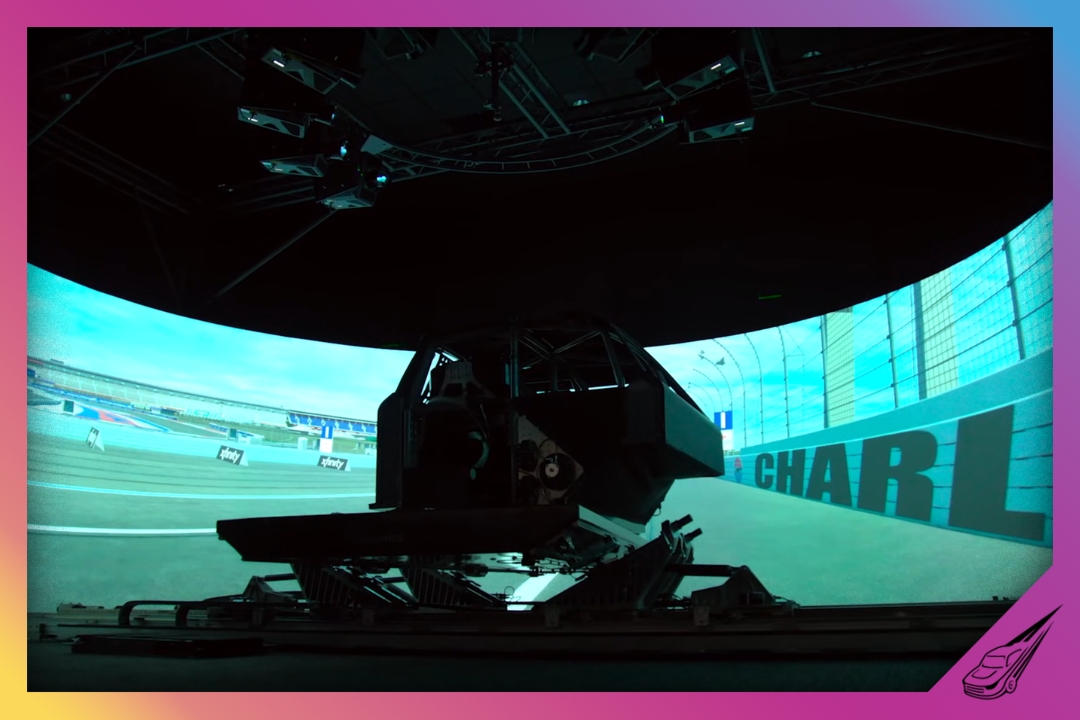
At first glance, it’s a familiar setup: a cockpit, wheel, pedals, and wraparound visuals.
But that’s where the similarities end. Teams run proprietary vehicle models, fed by years of telemetry, track scans, and tire data from partners like Goodyear.
In fact, every bump in the track is mapped so that every setup change can be tested instantly, with a number of changes to the track environment included that allow teams to get a handle on what they can with limited on-track time.
Engineers run through thousands of setup combinations, covering areas such as suspension, aerodynamic balance, and tire behavior, while sim drivers focus on ensuring the virtual model matches real-world performance.
That process, known as correlation, is the backbone of simulation work. If the sim is even slightly off, the methodology to find the right setup doesn’t hold up on race day.
Nowadays, the hardware itself has also made major strides.
Systems like the SimCraft APEX 6 GT, recently approved for Cup Series use under NASCAR’s Driver-in-the-Loop guidelines, are designed to replicate motion in a far more realistic way.
Instead of shaking the cockpit through hydraulics or actuators, these rigs move around the driver’s center of mass, thus controlling pitch, roll, and yaw independently across six degrees of motion, helping recreate the physical cues drivers rely on at the track.
For some drivers, “Sim time” has become a core part of the job. Others aren’t as convinced.
Some drivers are vocal about their preferences for real-world seat time over simulator work, reflecting a divide between drivers who grew up without this technology and those who rely on it heavily today.
Even so, this is the direction the sport is headed. With limited testing/practice time and tighter competition than ever, thanks to the NASCAR Next Gen car, simulation has become less of an advantage and more of a necessity.
Let us know your thoughts on this! Join the discussion on Discord or X, and remember to follow us on Instagram, Facebook, and YouTube for more updates.