
NASCAR’s first road course race of the season is in the books. With thrilling battles and drama in both the Xfinity and Cup Series races, who walked away as the biggest winners and losers from NASCAR’s trip to Texas?
Honorable Mention: Kris Wright
When the checkered flag fell Saturday afternoon, OUR Motorsports driver Kris Wright was the furthest thing from fans’ minds. The focus was on race winner Connor Zilisch and his seemingly aggressive on-track moves.
Really fast car, not much to show for it.
— Josh Bilicki (@joshbilicki) March 2, 2025
Started at the rear of the field after we had to fix a few issues after qualifying. Top 12 pace all day but a pit road speeding penalty at the end of stage two set us back. We were charging forward until the 5 car spun right in front of… pic.twitter.com/7bCuXJV4sv
However, a post on X from DGM Racing’s Josh Bilicki drew attention to Wright and his aggressive driving. Each week this season, Wright has had his fair share of haters. However, his response to Bilicki caused a storm of its own on X.
Honorable Mention 2: Carson Hocevar, Garrett Smithley, and SS-Greenlight Racing
Prior to race day, on Feb. 24, Garrett Smithley announced on X that he would hand over the duties of driving SS-Greenlight Racing’s No. 14 to Carson Hocevar. In his video, Smithley stated, “I’m not the best road racer,” something the stats would back up.
Hocevar, a Cup Series regular, qualified the No. 14 24th and hoped to improve on his start throughout the day. Unfortunately, on lap 5, Hocevar found himself the victim of the new turn 6A at COTA, the car buried in the temporary wall, and his day was over.
Biggest Loser: Alpha Prime Racing
The biggest story leaving Friday’s Xfinity Series practice and qualifying session was not 18-year-old Connor Zilisch pacing the field; rather, it was Alpha Prime Racing’s Chevrolets. This attention was not because the three-car team had a solid day; rather, it had one of its worst outings in team history.
Of the team’s three entries, only one, Brennan Poole, qualified for the race, sending Brad Perez and Parker Retzlaff home empty-handed. However, team owner Tommy Joe Martins took a wrap for the team’s tough day in an emotional post on X.
The worst day in company history & I take full responsibility for it. @Parker79p & @bradxperez are both great racecar drivers. I’m sorry to their sponsors & teams who trusted APR & myself. I haven’t put us in a position to succeed. I’m embarrassed, & will be for a very long time. https://t.co/YYZbCoejOA
— Tommy Joe Martins (@TommyJoeMartins) March 1, 2025
Honorable Mention: Carson Kvapil
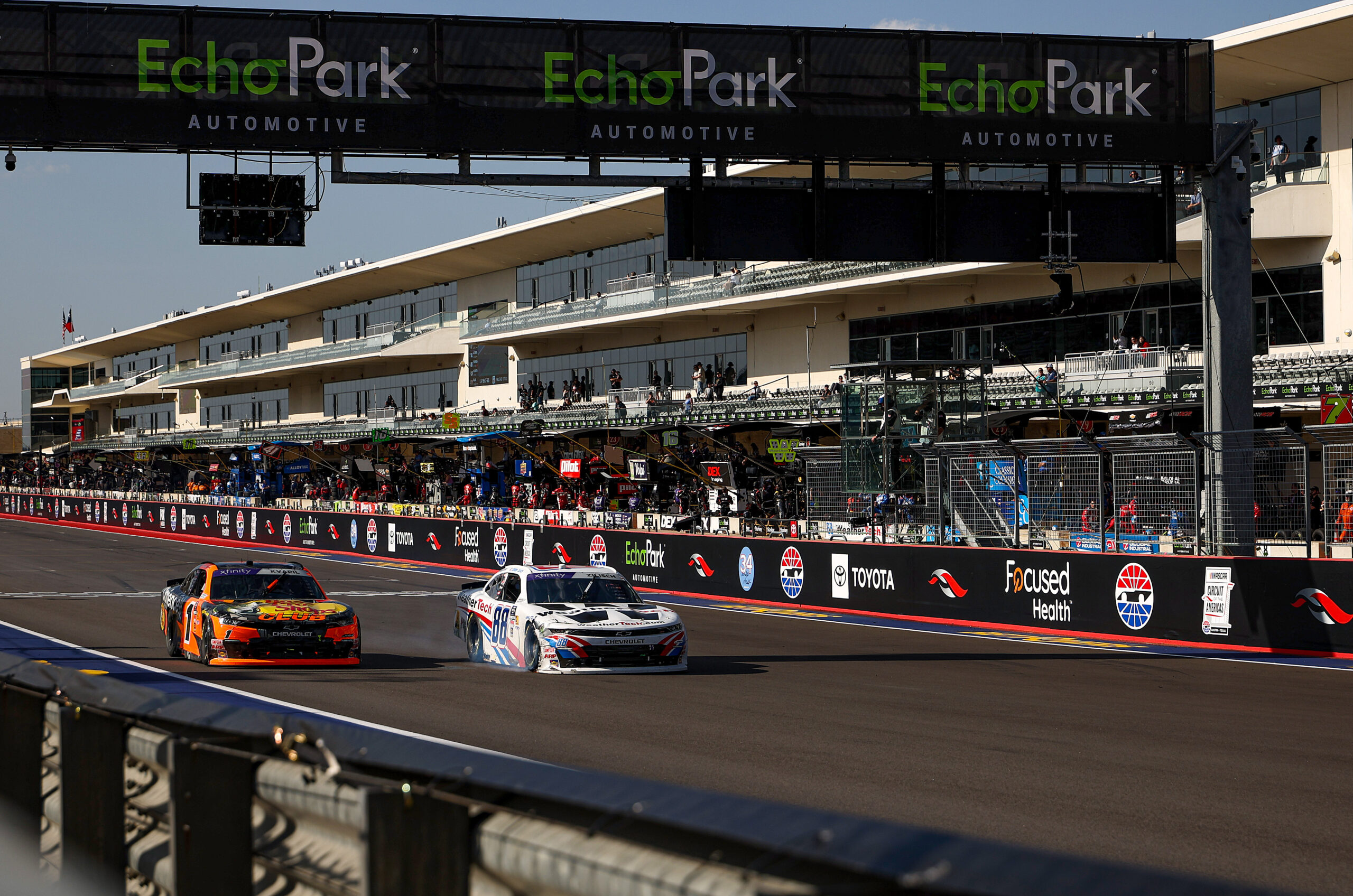
Carson Kvapil showed up and showed out at Circuit of the Americas, going head-to-head with teammate Connor Zilisch. In his first NASCAR National Series road course start, the short-track ace almost looked to have the win in the bag before cutting a tire.
While most expected Kvapil to have a learning curve on intermediate and road course races, Carson proved that he is more than ready for the challenges presented by this series. As the year goes on, look for Kvapil to threaten all types of tracks.
Biggest Winner: Connor Zillisch
While it’s easy to pick the race winner for the biggest winner of the week, Connor Zilisch’s masterful driver from last to first must not go understated. While he had a big week at Watkins Glen last fall, this past weekend secured Connor’s spot as the future of NASCAR.
Unlike his teammate Kvapil, some still feel Connor has a lot to prove on oval tracks. Going forward, fans will more than likely look past Zilisch’s skills on road courses to see what he can do on ovals. However, his efforts in a stacked field cannot be overlooked.
Honorable Mention: Kyle Larson
The state of Texas has not been good to Kyle Larson the past three seasons. With a best finish of 14th in the past two seasons at the state’s two tracks, fans of the No. 5 were hopeful for a rebound in 2025. While a race at TMS in May is on the way, success would not be the case at COTA.
After a tough start to the race, including a stop-and-go course-cutting penalty, Larson lost a wheel, and NASCAR subsequently parked him for two laps. A late spin ultimately placed Larson 32nd at the checkered flag, his worst career finish at the track.
Biggest Loser: Austin Cindric
Once considered a road course ace in the NASCAR Xfinity Series, Austin Cindric entered COTA with high hopes. After a solid showing in practice, Cindric qualified a disappointing 36th, a career-worst on a road course.
Cindric’s race day was no better as the now-veteran Cup Series driver finished a measly 25th. This was highlighted by a late-race incident captured on MAX’s in-car camera, which seemingly showed Cindric intentionally wrecking Ty Dillon on the front stretch.
Honorable Mention: Kyle Busch
Despite the doubts of fans, Kyle Busch had a solid showing Sunday at Circuit of the Americas. Despite not having the car to beat Christopher Bell or William Byron, Busch led the most laps and holds of drivers like Shane van Gisbergen and Christopher Bell.
Busch had a tough 2024 season, but the driver of No. 8 needed a solid start to the 2025 Cup season. Going forward, Busch and RCR need to put the past few seasons behind them if they want to succeed.
Biggest Winner: Circuit of the Americas
When NASCAR announced a shorter course for Circuit of the Americas, fans walked away with a mixed reaction. This circuit cuts down the circuit backstretch while allowing for more passing opportunities for the drivers.
Despite fan curiosity, this weekend’s race was a relative success; the late race action, including the four-car race for the lead, clean racing, and a potential last-corner pass for the win, made for perhaps the best Next Gen races in the history of NASCAR at COTA.
Tell us your thoughts on this! Join the discussion on Discord or X, and remember to follow us on Instagram, Facebook, and YouTube for more updates.