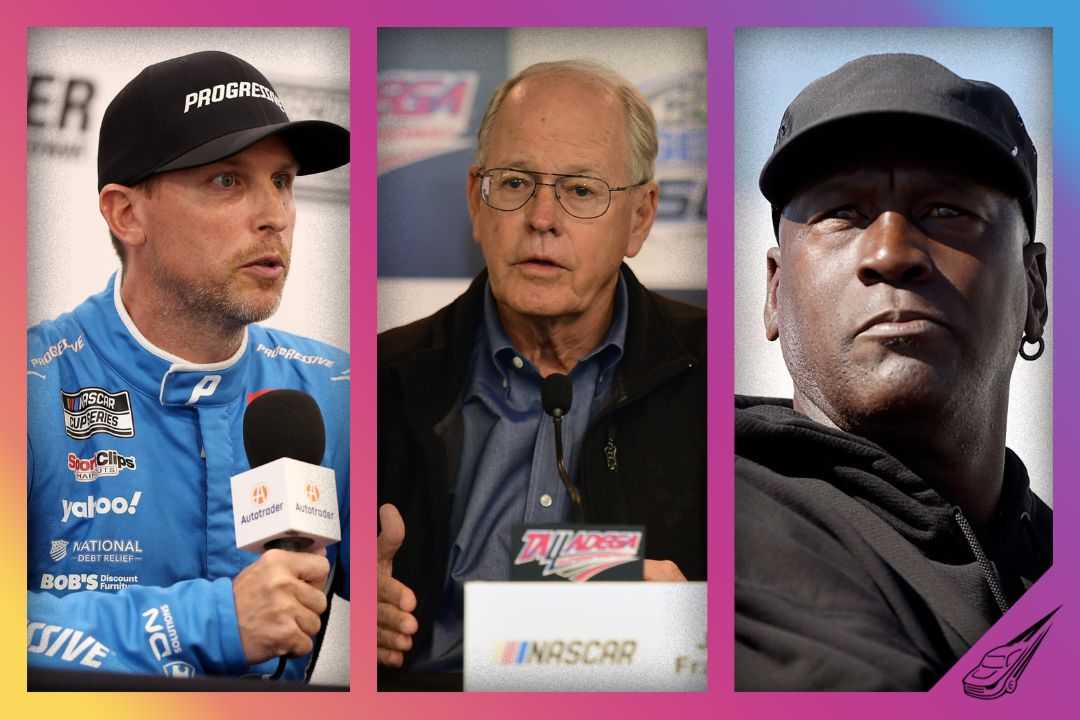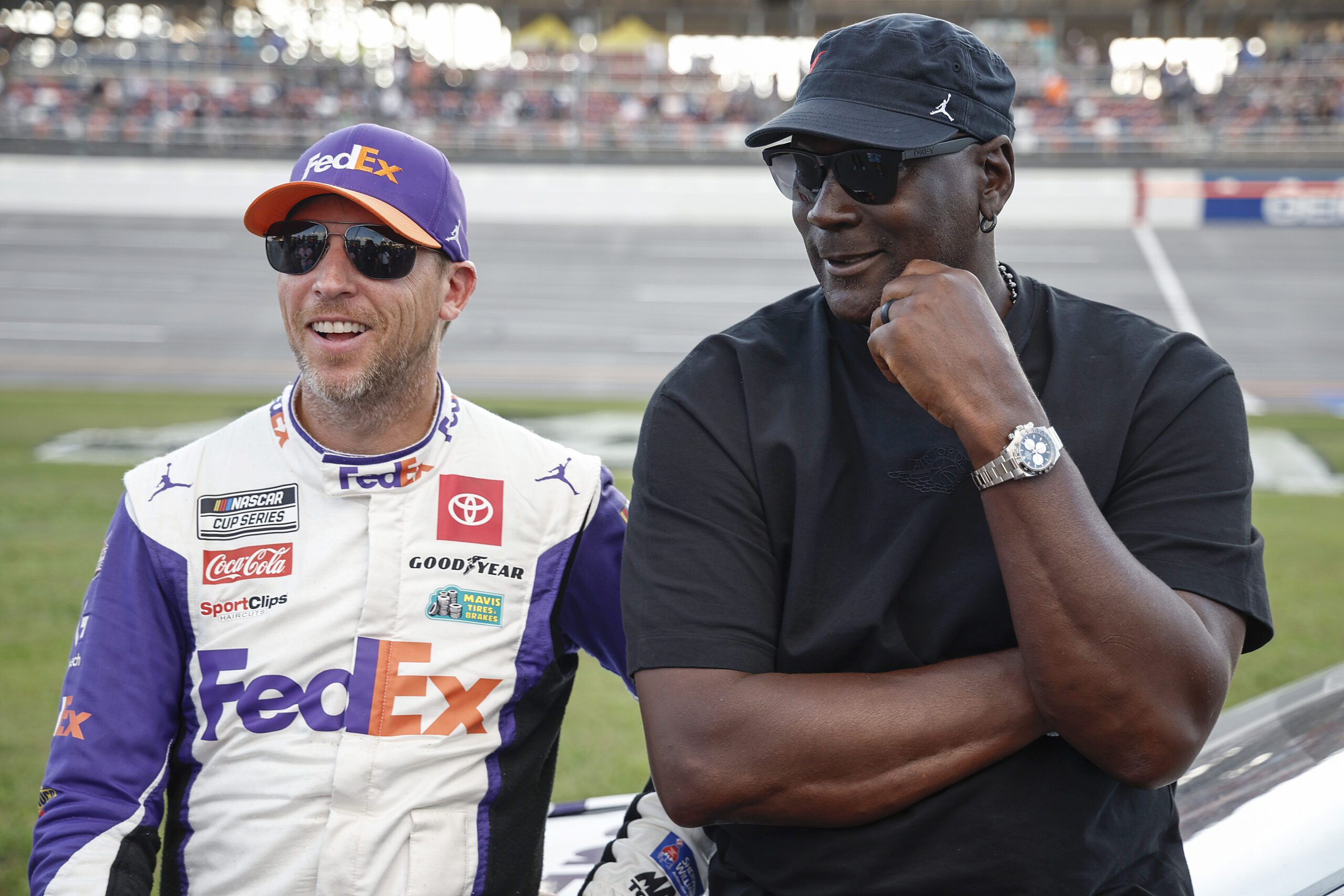
NASCAR Sues 23XI & FRM Claiming Teams “Embarked on a Strategy to Threaten, Coerce, and Extort”
What’s Happening? Though the ongoing lawsuit between Michael Jordan’s 23XI Racing and Front Row Motorsports lawsuit with NASCAR is awaiting its…
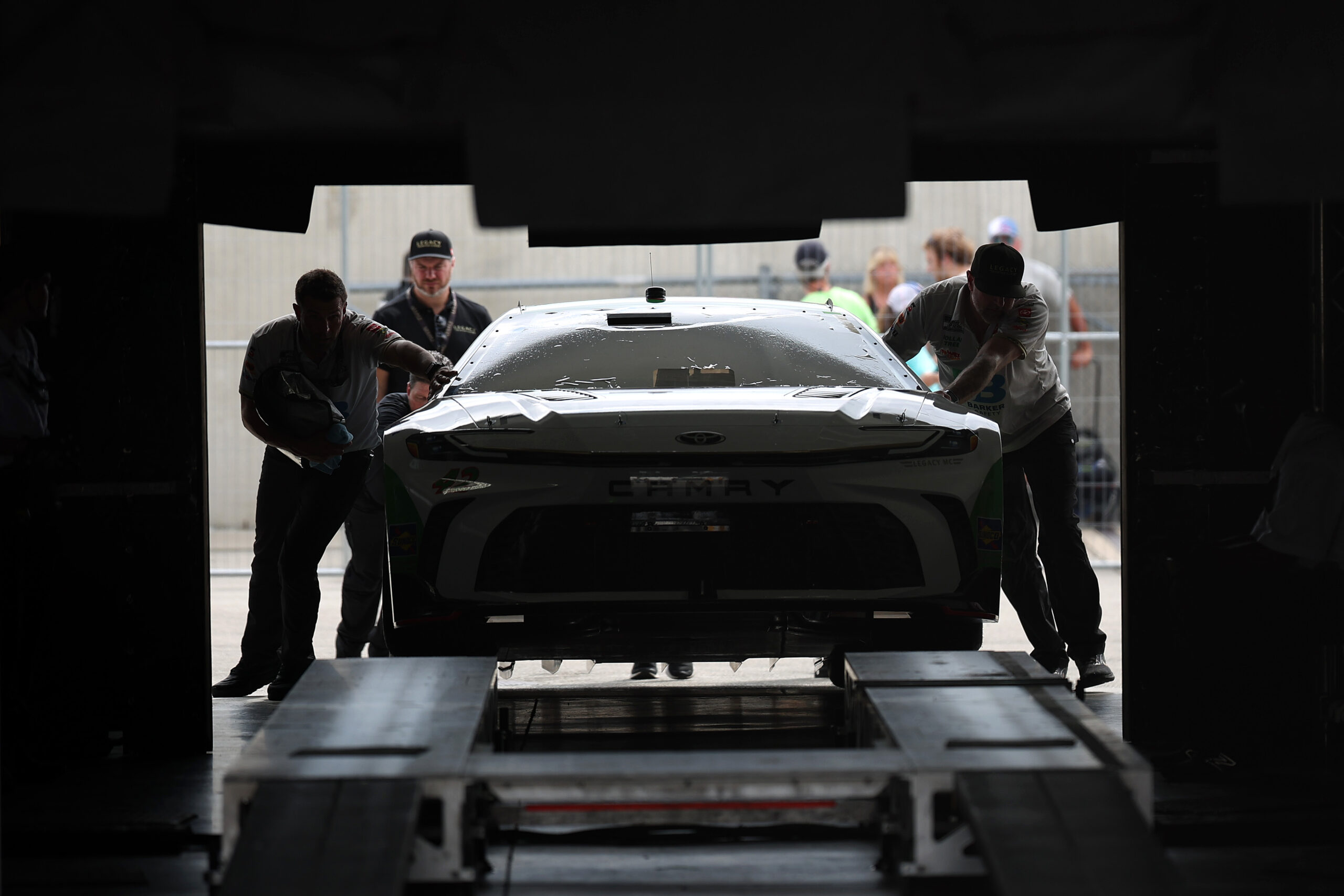

While the stars of NASCAR took Bristol this weekend, the legal team of 23XI Racing and Front Row Motorsports was hard at work as a filing on Friday gave fans a look into NASCAR’s Project Gold Codes.
The August 28 preliminary injunction hearing between NASCAR and 23XI Racing was packed with information. So much so that several items of intrest were placed on the back burner. One of these things to emerge in that hear was NASCAR’s “Project Gold Codes.”
At the time, little was known about what Project Gold Codes exactly entailed, beyond the fact that it was NASCAR’s planned response to a team boycott during the 2024 NASCAR Charter Negotiations.
These negotiations, which wrapped up in early September 2024, led to the ongoing lawsuit and a March 5 countersuit, in which NASCAR claims that the two teams and 23XI investor Curtis Polk, “embarked on a strategy to threaten, coerce, and extort NASCAR into meeting their demands for better contract and financial terms.”
After the hearing, the focus remained on the injunction, the charters, and the text shared by both councils, though, on that week’s episode of Actions Detremental, 23XI owner Denny Hamlin reffered to Project Gold Codes as “unfortunate.” But, for the most part, very few additional details emerged.
There was a slim yet realistic chance that little would come out about this plan from NASCAR, should the two sides come to an unlikely settlement or it not come up again. But, thanks to NASCAR’s countersuit and a filing from 23XI/FRM, those outside NASCAR headquarters not only got more information, but NASCAR’s plan in full.
What’s Happening? Though the ongoing lawsuit between Michael Jordan’s 23XI Racing and Front Row Motorsports lawsuit with NASCAR is awaiting its…
It’s no secret that had the teams boycotted, it would have been an exhibition race, such as the 2024 LA Clash or the 2024 Duels at Daytona. In the now public presentation from NASCAR titled “Project Gold Codes,” NASCAR introduces the idea, saying:
“Teams may use ‘disruption’ as a negotiating tactic, this presentation is not meant to capture all possible scenarios but rather present response options and mitigation techniques to those actions that may affect the on-track product.”
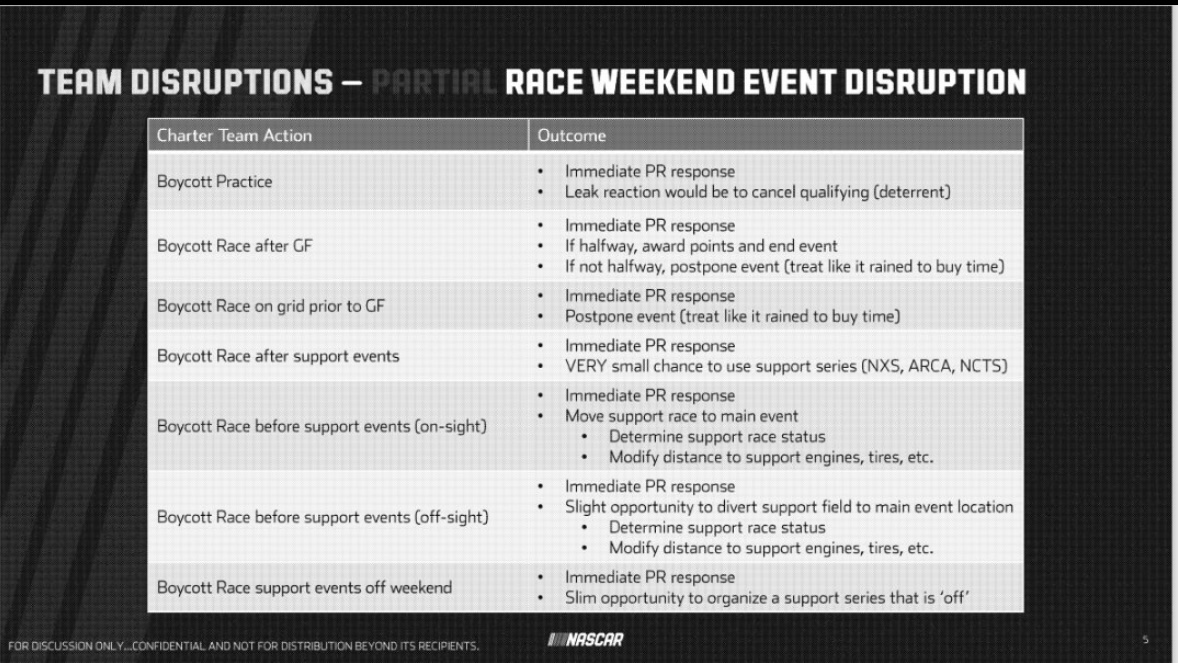
These slides presented a timeline for reactions based on when the teams could boycott, such as before and during a Cup Series race, and dependent on when the “support series,” the Xfinity, ARCA, or Truck Series, had a “small chance” race. This is, of course, notable as it clarifies that had Cup Series teams not competed, NASCAR would have opted to its lower divisions to hold the main event, including a note to “modify distance to support engines, tires, etc.”
This could have also seen schedule changes, with frequent mention of the support series diverting from their original destination to wherever the Cup race was being held during non-concurrent race weekends. In the event of a longer-term boycott from the teams, NASCAR even mentioned adding a “mid-week racing series” and “off-season and international events.”
Perhaps the most talked about is how NASCAR would have proceeded had the boycott looked to last beyond six, 12, or even 18 months.
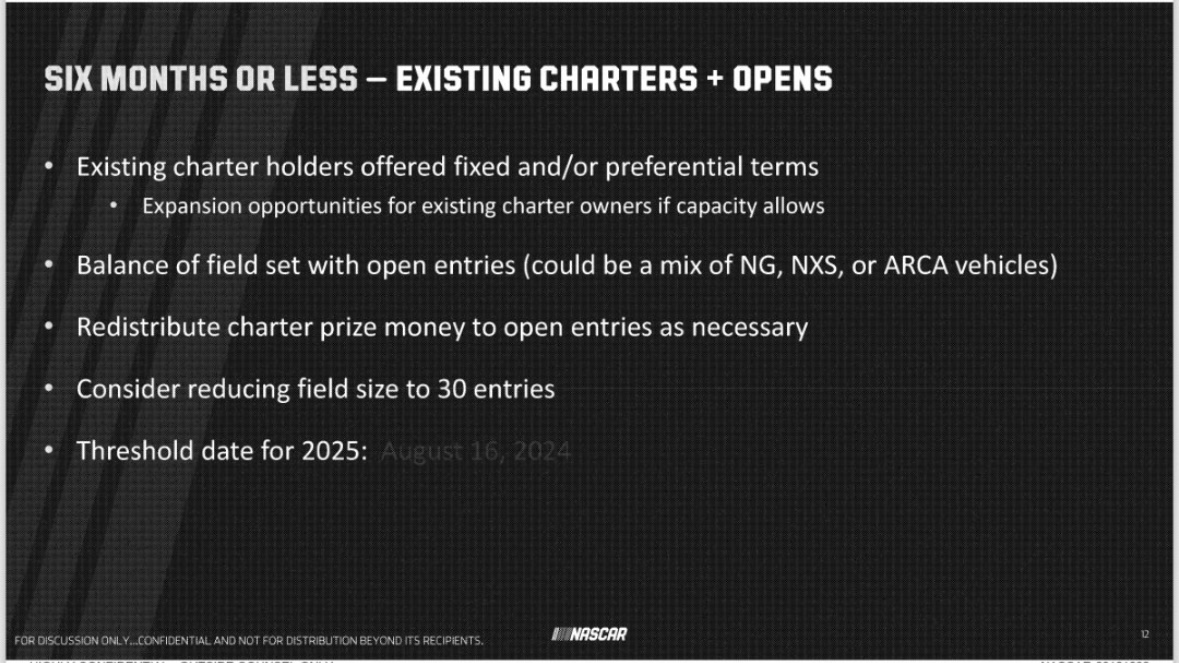
NASCAR first suggests that at six months, they would consider cutting the field to 30 cars, offering charter holders “fixed and/or preferential terms,” and filling what remains of the Cup field with other Next Gen car entries, Xfinity Series entries, and finally ARCA entries, with plans to help even the racing between the three divisions.
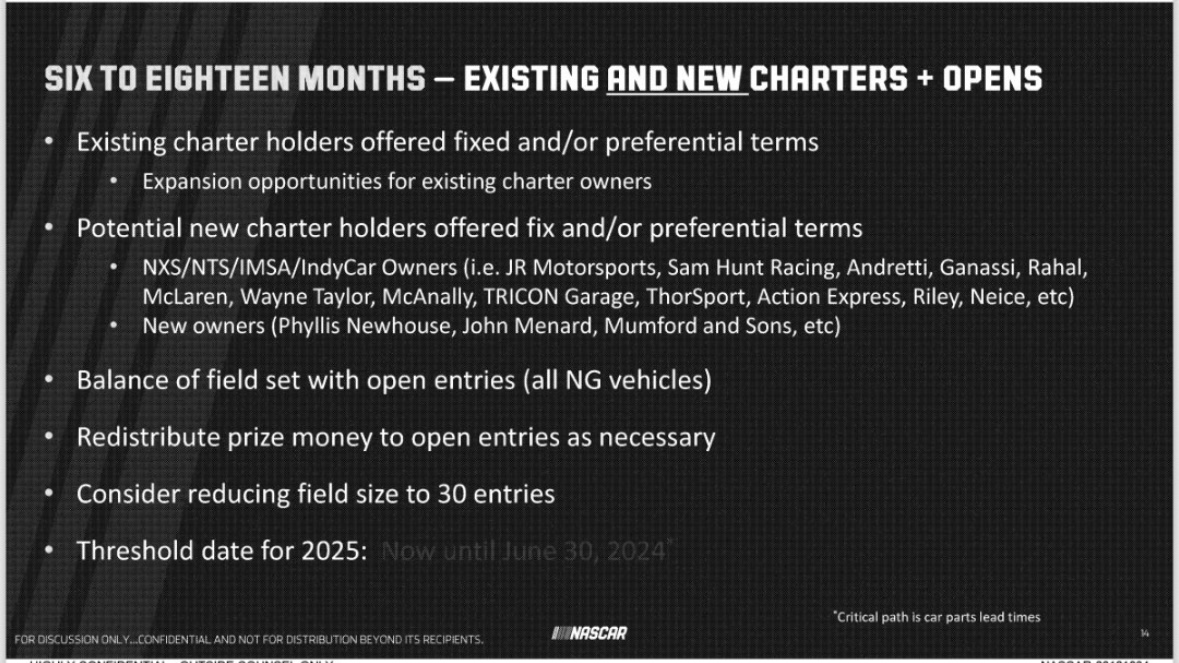
If a boycott looked to be within 6 to 18 months, NASCAR would offer charter holders those “fixed and/or preferential terms,” and offer charters to new teams, with notable listed potential suitors including JR Motorsports, Andretti, Ganassi, McLaren, ThorSport, Action Express, and John Menard. The field would preferably be all Next Gen entries, with cars having a “Generic body” with Roush Yates Engines, and could remain as low as 30 cars.
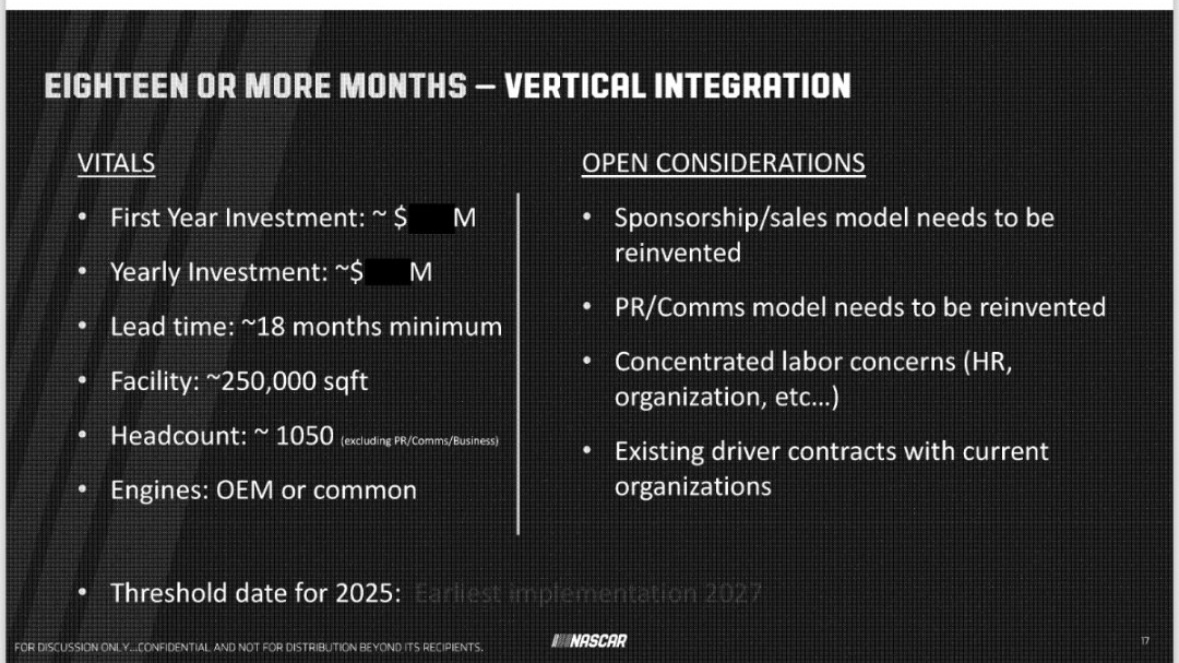
Finally, if this were to last over 18 months, NASCAR would roll forward with perhaps the most controversial move of all, vertical integration. This would see NASCAR field all employees out of a 250,000 square foot shop, with an estimated 1050 employees, and paying drivers roughly $2,000,000.
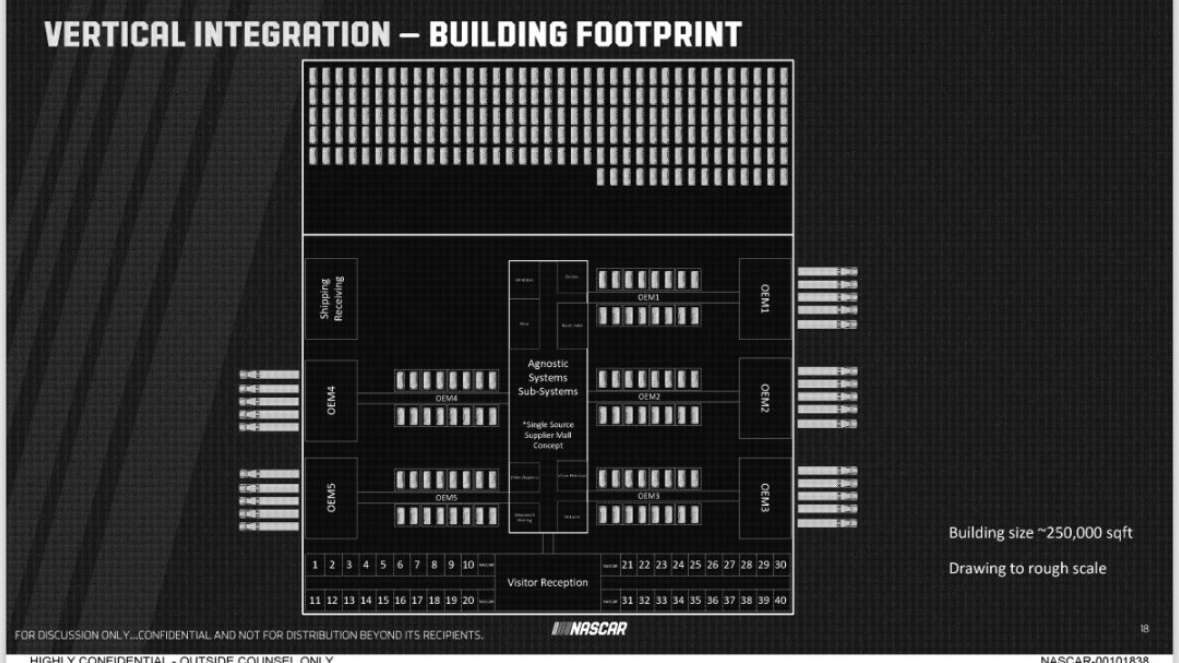
Notably, this plan does not give clarity on where the OEMs would stand; Hendrick Motorsports and RCR build Chevrolet engines. At the same time, Toyota and Ford have non-team-built engines, something frequently noted throughout this presentation. Still, a diagram notes room for up to five different OEMs and the potential for engines to be “OEM or common.”
Of course, this boycott would never have happened, and NASCAR never had to proceed with these industry-altering decisions.
Nonetheless, the information found within this plan shows just how nervous NASCAR was about negotiations on the 2025 NASCAR Charter Agreement falling through. Ultimately, 13 of the 15 charter owning teams would sign, with 23XI and FRM going down the path that has led to December’s antitrust trial.
NASCAR’s countersuit is just one of many storylines stemming from the two teams’ October 2, 2024, antitrust lawsuit filed against NASCAR. We have extensively covered all aspects of this lawsuit via the timeline linked below.
What’s Happening? The 23XI Racing and Front Row Motorsports lawsuit will continue for some time. However, many developments will occur along…
What do you think about this? Let us know your opinion on Discord or X. Don’t forget that you can also follow us on Instagram, Facebook, and YouTube.