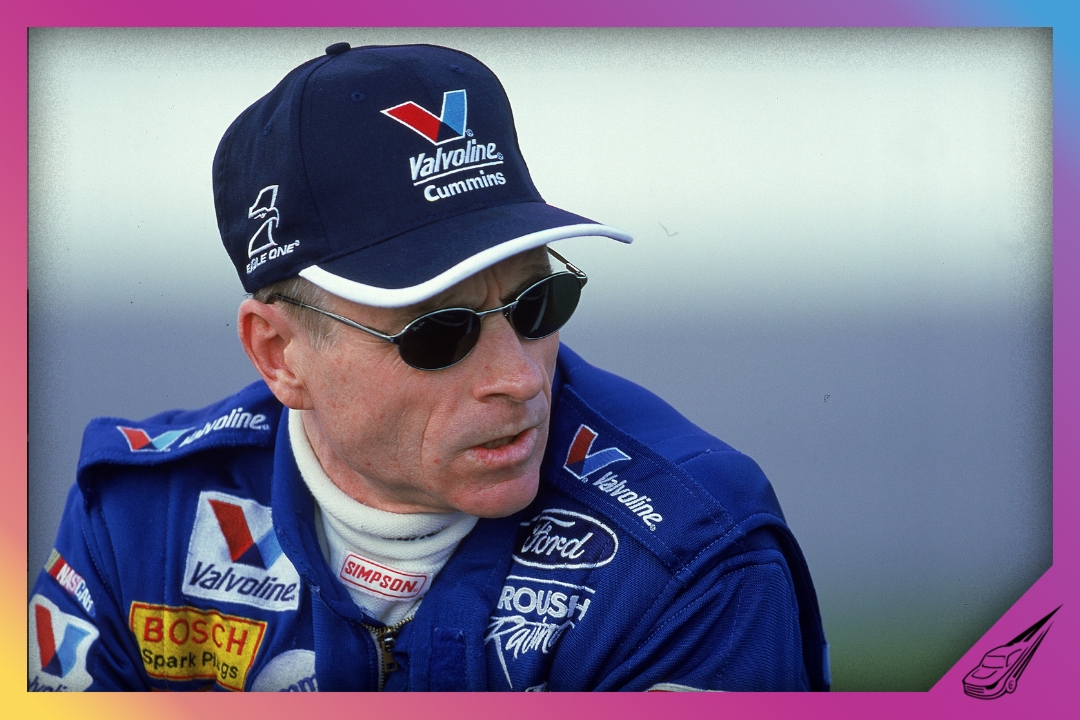


Mark Martin’s Never Lift is the story of a racer who built his life the hard way, one mile, one mistake, one lesson and one victory at a time. From childhood rides with his father to short track battles, Cup Series heartbreak, Hall of Fame validation and the discipline it took to walk away on his own terms, these excerpts capture the voice behind the legend. They are honest, funny, raw and deeply competitive, showing the people, pressure, pain and stubborn belief that shaped one of NASCAR’s most respected careers.
Releasing August 4, this autobiography gives fans a close look at the moments that made Mark Martin not just fast, but unforgettable, and the mindset that kept him pushing long after others lifted for good.
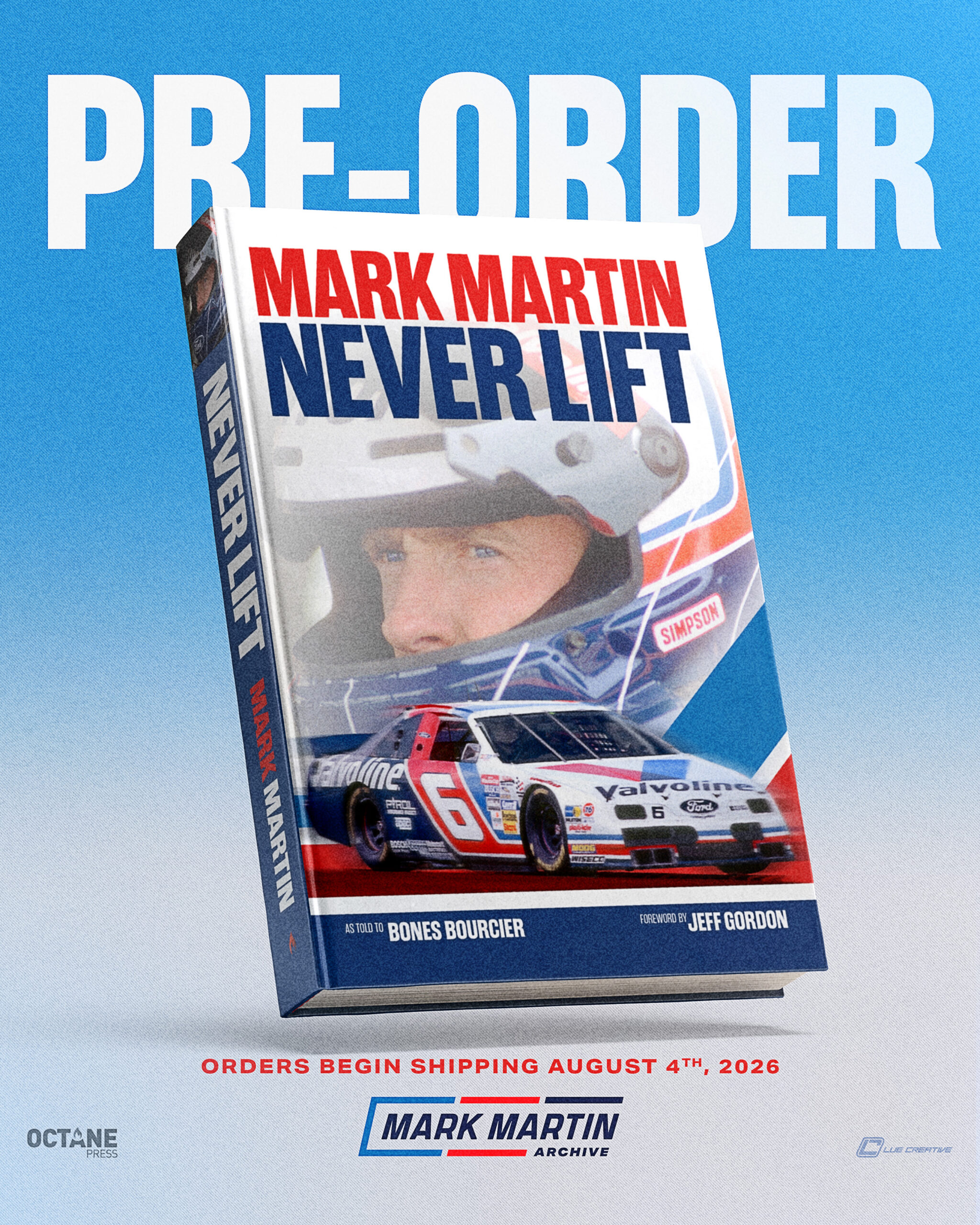
Learn more at https://markmartinarchive.com/products/never-lift
From Chapter 1
I lost my dad in 1998, but he never stopped being my hero. We built my first race car in the winter of 1973-74 in an empty bay at his trucking company. He once read something that had a humorous definition of the phrase “never lift.” It said: “to keep one’s foot firmly planted on the accelerator pedal with complete disregard to the possible outcome; can often end with catastrophic results, but with proper execution has been known to create legends.”
He saved that clipping, because it made him laugh. But he also swore by it and lived by it. He was that legend.
From Chapter 1
I had so many people around me on different teams, from one end of my career to the other, who gave it their all. Some of them, especially early on, worked regular 40-hour day jobs to support their families, then spent their nights at race shops and their weekends serving on volunteer pit crews. They got very little recognition aside from getting to pose for photos in victory lane if we won. But win or lose, they worked with enthusiasm because they loved racing. On every team, people like them are the cogs in the machine; each one of them means that you have one less thing to worry about.
From Chapter 1
I was officially the 40th person to be inducted into the NASCAR Hall of Fame. To think that I was part of that relatively small club of people was an amazing thing.
I’ve often said that my five IROC championships, collectively, were the high point of my career. In a driving sense, that’s true. But the Hall of Fame induction has to be the jewel in the crown.
Let’s face it, everybody lucks into a race victory every now and then. Richard Petty and David Pearson are the two winningest drivers in the history of the Cup Series, and even they got lucky a time or two. But you don’t luck into a hall of fame.
From Chapter 2
When I was just a little bitty kid, my dad would take me for rides and have me sit on his lap, steering the car while he worked the gas pedal.
We were driving on a rural road, with me steering, approaching a spot where the road narrowed and carried you across this one-lane wooden bridge. We were holding a pretty good speed, and my dad was not backing off …
Suddenly, it was crystal-clear. He expected me to steer this big car across that one-lane bridge.
I didn’t cry, because I didn’t have time to. But as we got close, I remember screaming, “I can’t do it!”
My dad said, “Then we’ll wreck.”
He never moved his hands toward the wheel. This was all up to me.
Whooomph!
That was the sound the wooden bridge made when we sped across it.
From Chapter 2
My dad was my hero, to a degree that’s hard to explain. In my eyes, he was the baddest mofo that ever lived. He could drive a truck, ride a motorcycle, even fly an airplane, so he was like Superman to me. He was not a big man, but he was tough and intense, the kind of tough guy who didn’t have to prove he was a tough guy. I never saw him get in a fight, and never heard a single story about him getting in one.
Now, that’s rare for a dude as scrappy as he was. But there was never a man who would dare stand up to him. Even when he got into the kind of argument that might have turned into a fistfight with most people, my dad never had to throw a punch. He was intimidating enough that the other guy always quieted down.
From Chapter 2
Every summer when school was out, my dad would take me along on at least one long trucking trip. We might drive out to California, load up on produce, and truck it clear to Pennsylvania.
By the time I was 13 or 14, I was his full-on co-driver. If he was tired, he’d slide out of the seat, without stopping, and I’d slide in. I drove just like he did, meaning as fast as the truck would go.
I was hauling up a long hill on some Interstate, catching another truck that was struggling to keep its speed up. As we started blowing past that other rig, my dad leaned over and flipped on the dome light. He wanted the other trucker to know that not only was he getting his ass dusted, but he was getting his ass dusted by a kid. By a child.
From Chapter 2
There are things I wish I’d done differently. I could have easily gotten better grades by applying myself more in class. I should have gotten more out of my education than I did, and I regret not taking it more seriously. I don’t think it’s ever been a real problem for me as I progressed through life, but since I had to be there anyway, I should have worked harder at it.
But I didn’t like school. It was a thorn in my side. First I wanted to ride motorcycles, and then I wanted to drive race cars. School was in my way.
From Chapter 2
By the time I was old enough to get a driver’s license, I had a stack of police tickets almost as tall as I was. There were motorcycle tickets and car tickets, most for operating a vehicle without a license, with a few speeding tickets mixed in.
Because of all those violations, the very minute they officially gave me my license, they also suspended it.
That’s a true story: They handed me the license, then said, “Okay, now give it back. Your license is suspended for the next three months.”
It was like a ceremony: They presented it to me, and I presented it right back to them.
From Chapter 5
When we started asphalt racing in 1977, we built a small trailer that we towed behind our ramp truck. The trailer carried a spare engine, a 55-gallon drum of racing fuel, our toolboxes and other parts.
We were on a winding two-lane, on our way to Fort Smith. Dad was driving. He caught a Volkswagen on a curve and immediately pulled out to pass. It looked clear when he started the move, but here came a dump truck, heading straight at us. Rather than running into the truck or squeezing the Volkswagen, my dad steered straight off the road and through a ditch.
The trailer broke away and flipped into the woods, scattering its contents: a wrench, a hammer, another wrench, just a trail of stuff, including our spare engine. The drum of fuel was out there, too; if it had exploded, it would have burned down the entire county.
From Chapter 5
Rockford Speedway in Illinois had an event called the National Short Track Championship. The race was not sanctioned by ASA or ARTGO, but all the big names came anyway.
Before 1977, we had never seen Rockford, but I qualified second to Trickle. Second!
For the 200-lap feature, the top six qualifiers were inverted. I started in the third row beside Trickle, and we worked our way to the front. Tom Reffner was leading when we got there. Just past halfway, some lapped cars got together just as we caught them. Reffner and I made it through, but Trickle had some damage and had to pit.
That left me chasing Reffner, and I know we were good enough to pass him. But we didn’t have to; Tom’s car started overheating, and by lap 176 he was done.
From there, no one could touch us. We won the National Short Track Championship.
From Chapter 6
Before the 1978 season, I had the bright idea that what we needed was a cube van, one that could carry a lot of parts and also pull the race car on a trailer. We settled on a Ford with a 460 big-block engine.
Just about every show on the ASA schedule was more than 450 miles from Batesville, and the ARTGO races were all in Wisconsin or northern Illinois, at least 500 miles away.
That cube van took a beating. We blew up three of those Ford 460 engines that season.
Keep in mind that this was years before every person carried a phone in his or her pocket. In 1978, breaking down meant that you might have to hike a few miles, knock on the front door of someone’s home in the middle of the night, and hope that they’d let you use their telephone to call for help.
From Chapter 6
Every week, I was surrounded by the gods. I really did put the best late model drivers from Wisconsin and Michigan on that high a pedestal. By paying attention to what they did, I learned when to run hard, and when to pace myself so I’d still have some speed in my tires when I needed it.
There’s an art to that, a feel that you need to have. You need to stay conscious of how your tires feel. If you’re loose, you’re thinking hard about your right-rear tire; if the car is tight, pushing, you focus your thoughts on the right-front tire. That feel is something you have to develop, and it doesn’t happen overnight. But week after week, I was lucky enough to see, up close, the way guys like Bob Senneker and Dick Trickle would execute a race.
Watching those great drivers, you could learn it all.
From Chapter 7
I always had a strong work ethic. But in 1979, when I was living in North Liberty, Indiana, working for Ray Dillon, it jumped into a higher gear. People would tell Ray that when they drove past his property at 1 a.m., the lights were on in my little shop. That was every damn night.
Late in November, my two employees traveled home to spend Thanksgiving with their families. I stayed in North Liberty.
On Thanksgiving itself, all the local restaurants were closed. But out past the edge of town, there was a truck stop, and I knew enough about truck stops to know that the good ones are always open. When I was too hungry to keep working, I drove to the truck stop and had my turkey dinner. Then I drove back to the shop. I’m sure I stayed there until well past midnight.
From Chapter 8
The Dillon Mark 2 chassis was built from ideas I’d had myself or in partnership with Ray. Every bracket and mounting point was right where I wanted it to be.
I have a simple philosophy on racing: You drive as fast as the available grip will allow. On equal tires, my car turned better, stuck better, and got off the corner better than anything else out there.
Within a year, Dillon sold 40 Mark 2 chassis. Trickle ordered one, as did Don Gregory, Butch Lindley, Rusty Wallace, Neil Bonnett, and Darrell Waltrip.
We had customers who regularly brought their cars to North Liberty for me to set up. I’d get the chassis right, and they’d pay me $100 cash.
I know it will sound odd to people that veteran racers would have a 21-year-old kid setting up their cars. It would sound odd to me if I hadn’t lived it.
From Chapter 8
In 1980, at Capital Super Speedway in Wisconsin, I had the worst crash I’d ever been in. Almost before the car stopped, I keyed the radio button and said, “I’m hurt. Get me some help.”
The biggest problems were with my left leg and ankle. There was a fracture in the lower part of that leg, but the real pain was farther down. My right ankle had a fracture, but the left ankle had five fractures.
A helicopter flew me to Madison General Hospital. A doctor there said, “Son, it looks like you won’t be racing again this year.”
I said, “I’ll be racing in 30 days.”
That was not a number I picked out of a hat. There was a gap of a month until the ASA series resumed on August 4. You give a racer a whole month, and he’ll recover from just about anything.
From Chapter 9
In 1981 at Nashville, in my third Cup race, I qualified on the pole. It was tremendously hot, and even though the race was at night, everyone expected it to be brutal.
I was sitting in the car, ready to go, when Dale Inman crouched down. Dale was Richard Petty’s cousin and crew chief, which meant that he was the winningest crew chief in NASCAR. He was also in a class of his own when it came to busting chops.
He looked me in the eye and said, “You got a hole drilled in that floorboard?”
“No, why?”
He said, “Because you’re going to melt and run out of it tonight.”
I was a small guy, and race drivers were supposed to be big and tough.
I didn’t say a word. But as he walked away laughing, I said to myself, “I’ll show you, you sonofabitch. I’ll show everybody.”
From Chapter 10
Somewhere or other, I ran into Dale Earnhardt in January of 1982. We didn’t know each other very well yet, but we’d gotten to be somewhat friendly in 1981. We talked about the racing I’d done in the past, and I mentioned that I still had videotapes of some of my ASA races.
Dale said, “Bring them by the house.”
So I did. At the time, he was single, living in a place on Lake Norman. The two of us go down to the basement, open a couple of beers, and start watching these races, talking about the different drivers: Trickle, Senneker, Eddy, all the heroes.
Then there’s this noise, the sound of a kid running down the stairs. It’s Dale Jr., who was 7 years old but looked even younger. Well, he quickly got a talking-to from his dad, who sent him right back upstairs.
From Chapter 10
My hope was that the people in the Cup garage would have seen something in me in 1982 indicating that I had potential. I knew I could drive. I knew I had as much desire as any driver, and probably more than most. I knew that the things I understood about race cars, from chassis to bodies, would have been beneficial to any number of teams.
But those were different times. You had Bobby Allison, Darrell Waltrip, Harry Gant, Buddy Baker, and Dale Earnhardt running the full schedule. Neil Bonnett and Cale Yarborough had the best limited-schedule rides. NASCAR was still in a period when the driver was the data-acquisition system, so every team owner and crew chief wanted that old driver who had been there and done that. They were not going to shove one of those guys aside to hire a 23-year-old Mark Martin.
From Chapter 11
It was at Christmastime in 1983, in Batesville, that I met Arlene. She was busy being a single mother of four daughters, and nothing about me suggested that I was a guy she’d be interested in. My existence revolved around racing, which was not on her radar. But I was immediately drawn to her.
I was only going to be in Batesville for another week. I mentioned that we ought to go out, but she shot that down. She said I could come to her house, and I did that a few times; we’d sit on her couch and talk for hours.
I had to leave for Wisconsin and the team I was now driving for, but I stayed in touch with Arlene by phone. In January, I drove back to Batesville just to see her again.
There’s no other way to say it: I was crazy about her.
From Chapter 11
In February of 1984, I stood outside the Cup garage fence at Daytona. I had no credentials of any kind; I’m sure I could have called someone at NASCAR, but I was too proud. I didn’t have a ride, and I didn’t want to be the guy who begs for a pass just so he can stand around. I bought an infield ticket, watched practice, and stood outside the garage fence, staring in. I saw team members carrying springs and shocks, playing with carburetors, and massaging the bodies of the cars, the way they always do at Daytona.
I also saw drivers walking back and forth from the transporters to the garages. I was literally on the outside looking in, knowing in my heart that I could run with any driver in the place but unable to prove it. That might have been the lowest point of my career.
From Chapter 11
The guy that Arlene met over Christmas in 1983 was not Mark Martin, the successful race driver. She found me when I was at the bottom, professionally. She met the humble me, the crushed me. And she liked me anyway.
I know this much: Arlene wasn’t seeing fame and fortune. My tax return from 1984 showed that I made $18,000, so it’s not like she had stars in her eyes when she said yes to marrying me.
Arlene is a tough cookie, as tough as women get, and she had to be tough to deal with the first few years of our life together. But she also has a beautiful sweetness to her, and a really good heart. In addition to being my wife, she is my best friend.
From Chapter 12
Walking back into the ASA pit area was different for me in 1984 than it had ever been before. “Humbled” is not a strong enough word to describe my emotions. I felt shame. The fans in the grandstands, who don’t always know the ins and outs of the sport, probably saw me as the guy who couldn’t cut it in NASCAR. And I’m sure there were racers who were glad to see me back there as someone who had tripped and fallen.
I mean, if you’d been a Late Model driver in 1978 and this kid from Arkansas showed up and skyrocketed to the top – taking a lot of attention away from you – wouldn’t you be happy that this kid’s big plans had crashed and burned? Wouldn’t it feel good to see him with his tail between his legs?
From Chapter 13
Alcoholism isn’t something you catch, like the common cold. It builds and builds; it’s a progression from innocent drinking to troublesome drinking to drinking that might be a problem, and finally to drinking that’s a giant problem everyone but you can see.
I was a long way down that road in 1984, and it just rolled onward through 1985 and ’86. I started to have what I would call “the uglies,” those ugly incidents where maybe you get mean in situations that don’t call for it. It happens again and again, and every so often you sprinkle in a night where things get really ugly.
Some people like to fight when they get drunk. Thankfully, I was not like that, but there were multiple occasions when I probably should have had my ass whipped.
From Chapter 15
I remember a Goodyear test at Dover when a rainstorm blew through. We put every vehicle we could find on the track, trying to dry it. I had a plain-Jane rental car, and I had it out there. Robin Pemberton was riding with me. I said, “I bet we can get around this place wide open. No lifting, no brakes.” He didn’t think I could.
Well, I ran several laps that way, foot to the floor. That clunker would max out at 110 miles per hour before I dropped down into the turns.
I ran hard until the steering wheel started to shake. That sensation was familiar to me. I said that we’d blistered the right-front tire. Robin didn’t believe it was possible to blister a passenger-car tire, so we stopped for a look. Sure enough, the tire was so hot that it was throwing off chunks of the tread.
From Chapter 15
At Rockingham on October 22, 1989, we finally had a day when everything went right, all the way to the checkered flag. It was my first Cup win, and Roush Racing’s first as well. And we won it in style, running all day with the leaders – mostly Rusty, Earnhardt, and Darrell – and being the fastest when it counted most.
I wish I could remember more about the victory lane ceremonies. I do recall thinking of that win as a team thing. We’d worked so hard and gotten so close, and it was great to see those guys so happy.
But a lot of the celebration became a blur. I think that’s true of any first-time win; so much is happening that you can’t absorb most of it. I wish I could go back and relive that scene and slow everything down a bit.
From Chapter 16
It’s New Year’s Eve, the last day of 1988. In a few hours, the calendar is going to change. It’s the one evening of the year when everyone feels like it’s okay to drink too much. They’re going to ring out the old and ring in the new, and, man, it’s going to be fun.
My night starts out innocently enough: one drink, two drinks, three drinks. But then it becomes a binge, and the uglies show up once again.
I’d been a control freak for a long time. I’d built my own cars, formed my own teams, made my own deals. At race time, the steering wheel was in my hands. Mine. But when I woke up on the first day of 1989, I admitted at last that there was one thing I could not control.
I told myself, “That’s it. I’m done.”
And I was.
From Chapter 17
I have a memory from the 1990 Daytona 500 that’s funny now, but was not funny at the time. I hadn’t been a big coffee drinker, but Folgers was our new sponsor. That morning, I had a cup not long before it was time to get in the car. That was a bad idea. Midway through the race, I had to pee so bad that I thought I’d never make it until the end. By the time the checkered flag waved, I was in terrible pain.
As I drove back toward the garage area, I noticed a porta-potty. I stopped the car right there, climbed out, and headed straight for the door. Thankfully, it was not occupied.
Never again did I drink coffee on the morning of a race.
From Chapter 21
In early February of 1995, my motorhome was parked in the infield at Daytona International Speedway. Arlene and I were inside, and it was a nice day, so everything was opened up, with only the screen door between us and the outside world.
All of a sudden, that screen door flew open. A man stormed right in, took a quick look around, and sprawled out in a chair. He never knocked, never asked if he could come in, never said hello. He just fell into that chair and started talking about racing.
It was Paul Newman.
A few days later, the two of us were standing side by side in victory lane, having just won the Rolex 24, one of the biggest sports car races in the world.
From Chapter 21
Through ASA, ARTGO, and especially NASCAR, I had developed a habit of trying to make my very first practice lap jump straight to the top of the timing screens. It became my signature, and I brought that same mentality to IROC.
It was always cool to crawl out of the car and see the IROC mechanics looking at the timing screen and saying, “He does that all the time!” That was a badass feeling, hearing those guys brag on me.
From Chapter 21
I was deadly serious about those IROC races. Don’t get me wrong, if I fell out or had a bad run, it didn’t kill me like it did when I had a lousy day in the Cup car, because driving the Cup car was my job. But suiting up for any race, NASCAR or IROC, the feeling was the same. It was my chance to show everyone that I was the best driver on that day.
Going all the way back to beginning of IROC, there have been stories about this driver or that driver not taking it seriously, showing up just for the money and the fun.
I never raced anything just for fun. That was not part of my makeup. And I had enough hard battles in IROC to know that the best guys were there to win, just like I was.
From Chapter 22
With TV, the NASCAR audience multiplied many times over, and the difference between the old-line NASCAR fans and those just discovering the sport was incredible. I’ll bet most of the 18,000 folks at Nashville in 1981 were diehards who grew up with the sport. They could relate to the drivers. Whether they cheered for Richard Petty or Darrell Waltrip or a kid named Mark Martin, they saw us as human beings, real people.
But to the newer fans in the ’90s and later, we were celebrities. We were TV stars.
When we lived in Greensboro, I stopped one day at a gas station. As I was filling my tank, I noticed a woman at the next pump staring at me. She was crying. She could not believe that she was standing that close to a NASCAR driver.
It’s hard to explain why, but I felt uneasy about that.
From Chapter 22
The qualifying trick at Talladega and Daytona was to run high-rebound shocks on the rear. The shock compresses easily, but it doesn’t return to full length. The back of the car sinks down and stays down. It’s a way of keeping that rear spoiler out of the air, cutting drag.
With the cars tied down that way, you almost needed a boxing mouthpiece to keep your teeth from smashing together. No one thought a driver could hang on that way for a race distance, so the teams would install more forgiving shocks after qualifying.
At Talladega in ’97, I told my team, “We’re racing with those shocks.”
For 500 miles, my car handled like a bucking bronco. But I passed Gordon with 31 laps to go, and from there, no one could touch me.
Larry McReynolds, Earnhardt’s crew chief, told someone, “That crazy sonofabitch ran 500 miles with qualifying shocks!”
From Chapter 25
I believe in magic cars. No team has ever built two cars that were absolutely equal. You can build them from the same blueprints, from the same batch of steel, welded in the same week by the same welder on the same jig table. The bodies can be hung by the same man to the same plans. You can drop in engines with matching dyno numbers. You can put identical chassis setups under those two cars. But as soon as you haul them to the track, you’ll find that one is better than the other.
No one can tell you why. People have with different theories, everything from the heat of the welds to the difficulty in duplicating a curve when you bend two pieces of sheetmetal. I’ll stick to my magic-cars theory. Every now and then you’ll get one, and you shouldn’t try too hard to figure out why.
From Chapter 25
My primary interest was my own performance. That’s the competitor in me. I wanted my teammates to do well, but if I was slow and finished five laps down, I wasn’t going to be ecstatic just because one of them won. You could look at it the other way around, too: If I won and the other Roush cars had a tough day, I wasn’t going to be too upset. In any sport, you’ve got to be a bit selfish.
From Chapter 25
When I crashed at Daytona in 1999, I knew my left wrist was damaged. My left knee hurt, too, from smacking against the steering column. And I remember my ribs throbbing; one of them had been chipped.
They checked me over in the infield care center. As a couple of the medical people came walking back down the hall, I heard one of them say, “Yeah, his wrist is fractured.”
They fixed me up with a splint that immobilized my wrist and went up the underside of my arm. Back in the garage area, the TV people caught up to me. I didn’t dare use the word “fracture.” Why share your vulnerabilities with your rivals?
They asked if I’d be okay to race the next night, and I said, “I’d be ready to drive tonight. If they were starting in five minutes, I’d line up and go.”
From Chapter 25
I found out in the summer of 1998 that I had a serious degenerative disc problem in my lower back, which led to instability in my spine. The medical term for my condition was spondylolisthesis, which is a fancy way of saying that a vertebra has slipped out of position and is putting pressure on the one below. That nerves get compressed, which causes the flashing pain that people associate with a pinched nerve. At times, the pain was brutal. In 1999, it got to where I was asking the doctors for cortisone injections every two or three months, and any doctor will tell you that they don’t like a patient to get cortisone more than twice a year.
From Chapter 26
Earnhardt went through a stretch in 1993 when he decided that he needed to test me in practice. We had been racing together for a long time, but suddenly he was pushing my buttons like I was some new guy he was trying to figure out. In the first practice at New Hampshire, there was Dale, waiting on me again.
Well, I was tired of playing that game. When Dale got next to me entering the corner, I gave my car a little juke to the right and knocked that black #3 up into the marbles. He didn’t crash, but he had to work hard not to.
Benny Ertel, who would later be my business manager, was in the garage area when Earnhardt climbed out of his car and said, “I think Mark’s had enough.”
He never tested me again, and our relationship was back to normal.
From Chapter 27
On an asphalt track, the last two or three tenths of a second are in the slip, that last little bit of rear-end grip. If you go past that slip, you’re too far sideways and you’re losing time. But if you don’t get to that slip and you’re not riding that razor’s edge, you’re not as fast as you should be.
It’s so much harder than it looks. Once you get past two or three degrees of being sideways – which is so minor that someone watching might not even notice it – you’re going to have diminishing results. Fifteen degrees sideways might look cool on TV, but it ain’t fast.
But there was also a genuine speed advantage in driving within that tiny bit of slip. Two or three degrees, that’s where it’s at. That was my zone.
From Chapter 27
It’s impossible to overstate how much it will help any young driver to learn about race cars and understand how a chassis works. When I started racing pavement, I knew I couldn’t outdrive Larry Phillips. When he beat me, I took my ass-whipping, but I didn’t like it. I went home and improved my car until I could run with him, then improved it to where I could beat him.
I never lost that mindset. When I started in ASA, I couldn’t outdrive Dick Trickle. When I got to NASCAR, I wasn’t going to outdrive Earnhardt. But I gave myself a chance by making my cars better.
No matter where you live or what you race, you’re going to face some version of Larry Phillips, and some version of Dick Trickle. You can beat those guys, but you might have to work hard and get your hands dirty.
From Chapter 28
In 2002, Winston had the “No Bull 5” program: If a driver finished in the top five at one of five designated races, he’d earn a $1 million bonus if he won the next designated race. I was eligible in the Coke 600, and I loved Charlotte. The surface was old, so it came down to having the right car and the driver’s ability to live with that fast, worn-out track for 600 miles.
For the last 40 laps, Matt Kenseth was chasing me. I’m not sure I ever attacked lapped traffic as fiercely as I did that night. The TV guys talked about how hard a man will drive for a million bucks. Well, it wasn’t the money. I hadn’t won a Cup race in two years. It would have been easier for Matt to take a bone away from a bulldog than to take that win from me.
From Chapter 30
In 2009, I won five races. I had also won five times in 1993, and seven in ’98, but those came in a period when victories were almost expected. We looked at winning as the reason we went racing, and when it happened we didn’t celebrate like we should have. When I started with Hendrick Motorsports in 2009, I hadn’t won since October of 2005, and I had a huge desire to achieve one more Cup victory. We beat that goal by a bunch.
I had turned 50 just before the start of the season, but I still knew how to win. I still knew how to go fast, too. That season I qualified on the pole seven times, and I promise you that no 50-year-old driver will ever do that again.
From Chapter 32
Some drivers want to race forever, which would be fine if we all could be competitive forever, but that’s not possible. Too many of them hang on and spend their final few seasons running poorly in a series where they used to kick ass. They can’t be fast anymore, but they can’t quit. I didn’t want to be one of those guys. I knew that change was inevitable, so I embraced the idea that the next chapter was coming. It wouldn’t be the same as the last chapter, but it’s not supposed to be. Once you accept that, there’s no reason the next chapter can’t be as fulfilling as the one that just ended.
I’d done one thing for 40 years, and I’d done it well. Now it was time to do other things.
From Chapter 34
People make so much out of the fact that I didn’t win a Daytona 500 or a Cup championship. Well, Dale Earnhardt won the Daytona 500 once. Darrell Waltrip won it once. Junior Johnson won it once. LeeRoy Yarbrough won it once. David Pearson won it once. We’re talking about some of the most legendary drivers in the history of stock car racing. Would they be any less legendary if they had failed to get that one victory?
As far as the championship, I finished second in the standings five times: twice to Earnhardt, once to Jeff Gordon, once to Tony Stewart, and once to Jimmie Johnson. Those are four of the greatest drivers I ever raced against, and four of the best NASCAR drivers who ever lived.
If someone looks at my career and thinks it wasn’t complete, that’s their hang-up. It was complete enough for me.