
How Atlanta Motor Speedway Has Evolved

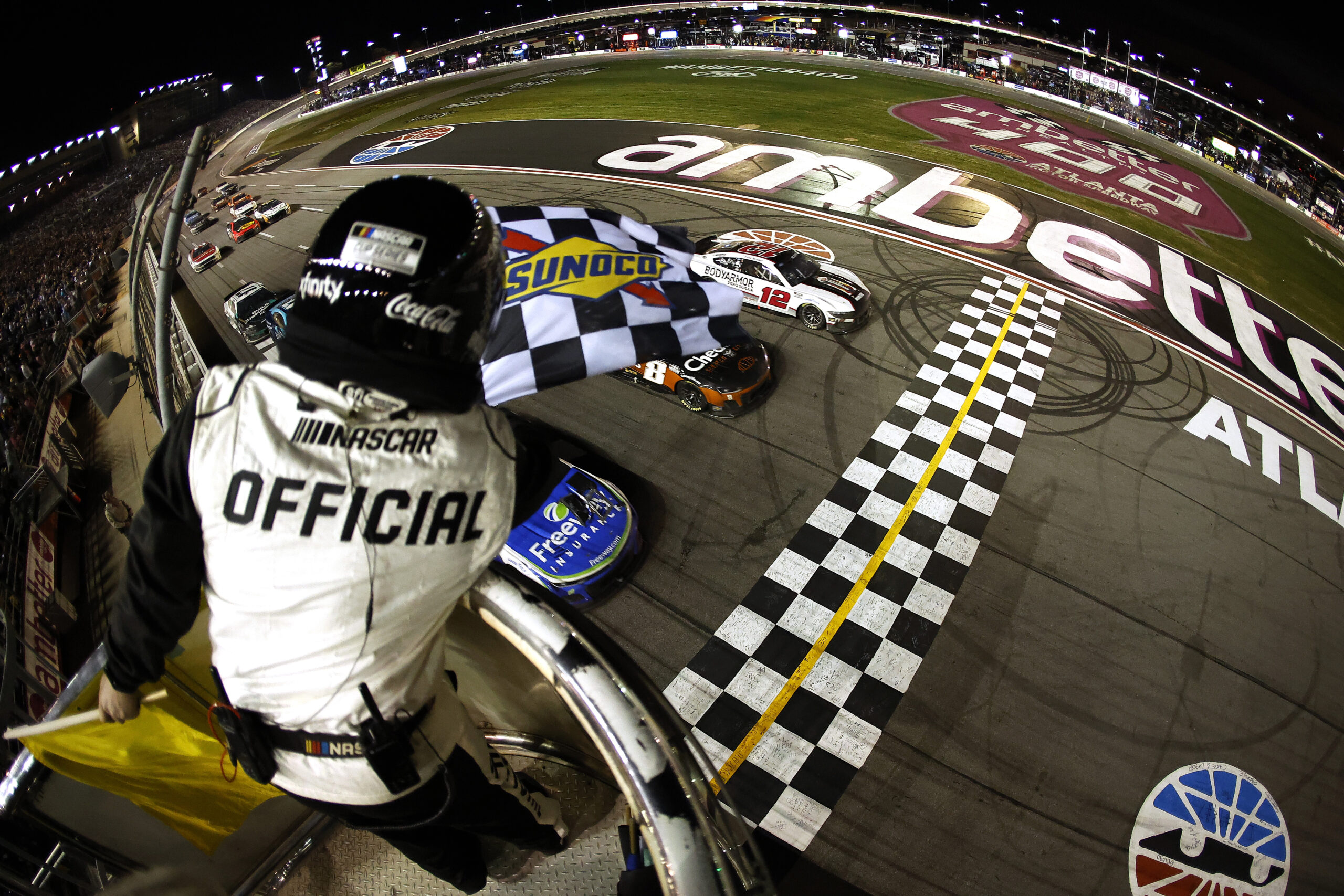
HAMPTON, GEORGIA - FEBRUARY 25: Daniel Suarez, driver of the #99 Freeway Insurance Chevrolet, crosses the finish line ahead of Kyle Busch, driver of the #8 Cheddar's Scratch Kitchen Chevrolet, and Ryan Blaney, driver of the #12 BodyArmor Zero Sugar Ford, to win the NASCAR Cup Series Ambetter Health 400 at Atlanta Motor Speedway on February 25, 2024 in Hampton, Georgia. (Photo by Alex Slitz/Getty Images)

What’s Happening?

All throughout Atlanta’s rich history, it was a fan-favorite (and driver-favorite) track, and that tradition continues through today. Dale Earnhardt Jr. even considers Atlanta race tickets to be the hottest tickets on the circuit. And though since 2022, AMS raced like a superspeedway-style track, that wasn’t always the case. Atlanta Motor Speedway has gone through many different facelifts throughout its history. So, this week, we thought it would be fun to take a look back at all the different layouts AMS has had, from the track’s opening in 1960 to the present day. Here’s how Atlanta Motor Speedway has evolved (and continues to evolve) through the years. Check it out!

Founding and Financial Woes (1960s)

The Atlanta Motor Speedway was founded in 1958 by the First Georgia Securities Corporation, with an inaugural NASCAR Cup Series race scheduled to take place in late November of 1959. However, the facility went through several delays, postponing the opening of the track. The newly built Atlanta Motor Speedway officially opened for business in the summer of 1960, with its first NASCAR-sanctioned race taking place in late July of that year. Around that time it was also confirmed that a second annual fall race would be run at the track, this one taking place in late October.

And just like that, the Atlanta Motor Speedway was a permanent fixture on the NASCAR Cup Series schedule. That’s not to say that the facility didn’t face its troubles. There were imperfections and violent bumps all over the racing surface, with USAC spearheading a campaign to resurface the track and add in protective guardrails. In addition to all of the track’s physical problems, it also constantly changed leadership, with track President Alf Lester being challenged by several industry insiders. The track also filed for Chapter 10 bankruptcy in 1971.

Following the track’s 1971 bankruptcy, it received an overall in management. Walter Nix and L. G. DeWitt became track executives and brought the Atlanta International Raceway into the modern era. Under their leadership, they saw AIR host the 1986 Winston, and in 1987, the track started to host the NASCAR Cup Series finale. That same year, Roger Penske offered to purchase the track, but Nix and DeWitt declined.

Winston Cup Championship Host Track (1987-2000)

The initial configuration of the Atlanta International Raceway (later renamed to Atlanta Motor Speedway) was a “true oval,” meaning that it lacked the signature dogleg that it possesses today. The track length was 1.54 miles, with banking in the turns set at 24 degrees. Though the straightaway banking wasn’t specified, track officials stated that they were “banked slightly. In the photograph below, you can see the front stretch of the Atlanta Motor Speedway back in the 1990s.
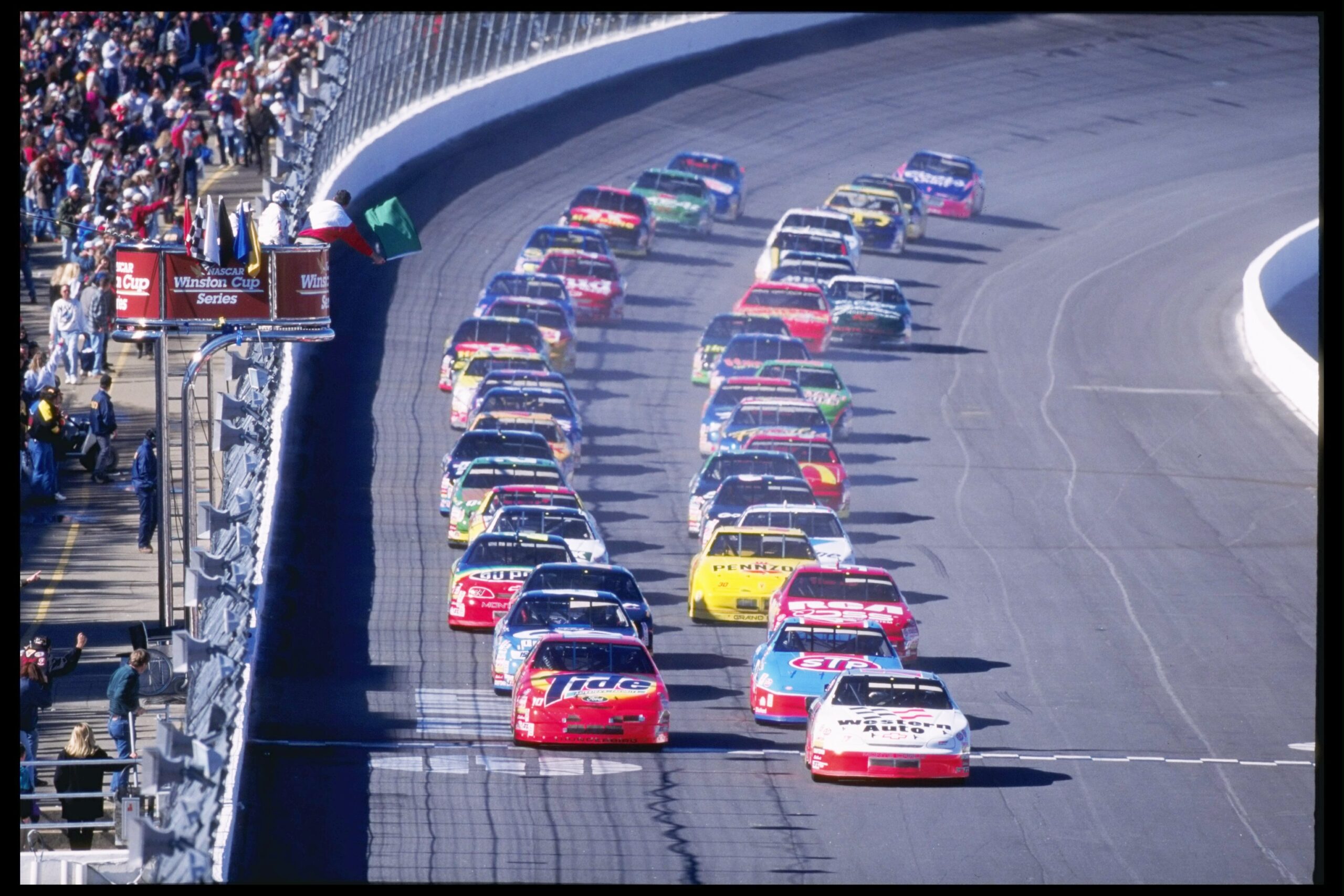
Photo by David Taylor

Beginning in 1987, the Atlanta Motor Speedway started hosting the NASCAR Championship weekend. In fact, to this day the track is the second-longest tenured host of the Cup Series season finale, hosting it for 13 years. For the first 10 years of it hosting the NASCAR finale, the Atlanta Motor Speedway retained its true oval shape. Some classic championship battles took place on this original configuration, including the arguably greatest championship battle in the history of the Cup Series in 1992.

This configuration of the AMS is also where Richard Petty raced his final laps as a driver and Jeff Gordon raced his first. In addition, this version of the track hosted five of Dale Earnhardt’s seven NASCAR Cup Series Championship victories.

“Cookie Cutter” Reconfiguration (1997-2021)

Bruton Smith, then owner of Charlotte Motor Speedway and eventual founder of Speedway Motorsports Incorporated, entered negotiations to purchase the Atlanta Motor Speedway in February of 1990. DeWitt initially dispelled any rumors of the track being up for sale, but the transaction became official on October 24th of that year. It was reported that Smith paid over 19 million dollars for the facility.

Under Smith’s ownership, little time was wasted making changes to the track. In 1992, a 2.5 mile infield road course was added, making for the possible transition for the track into a “roval”, similar to what Charlotte Motor Speedway has today. Though NASCAR never used this configuration, Legends Cars did race on the road course.

The first big reconfiguration of the NASCAR portion of the track came with the 1997 repave. These renovations were announced in 1994, with a completion date set in 2000. They included an expansion in seating by 68,000, luxury press boxes, and a dog leg. The latter change essentially transitioned Atlanta Motor Speedway into a quad-oval, a shape it still holds today. Meanwhile, the banking in the turns remained at 24 degrees with a 55ft racing surface. In addition to the dogleg, a quarter-mile oval was added to the front stretch, incorporating the finish line.

Atlanta Motor Speedway kept this configuration for 34 years before being reconfigured into a superspeedway. This configuration also saw some classic NASCAR moments. These moments include Dale Earnhardt’s 75th win in a photo finish against Bobby Labonte, Kevin Harvick’s first win in a photo finish against Jeff Gordon, and Jeff Gordon’s 85th win against protégé Jimmie Johnson.

Superspeedway Reconfiguration (2022-Present)

When it was first announced that Atlanta Motor Speedway was going to be reconfigured into a superspeedway, it was met with skepticism by fans and industry insiders alike. Denny Hamlin, unsurprisingly, was one of the most outspoken critics. Nevertheless, the plan was in motion. In 2022, the track was officially reconfigured into a mile-and-a-half superspeedway-style track. It maintained its dogleg, cookie-cutter shape, but banking in the turns was increased to 28 degrees. In addition to that, the racing surface was reduced from 55ft all around to 40ft in the turns, 42ft on the backstretch, and 52ft on the frontstretch.

Despite initial outcries, this version of the Atlanta Motor Speedway has proven to be more popular over time. The racing is different from that of Daytona and Talladega, with luck playing less of a hand in favor of overall skill. The track surface was also paved to age rapidly. The rapidly aging asphalt, which had been a topic of discussion amongst NASCAR fans on Reddit, meant that handling was and is a major factor during these races.

Under this configuration, the racing product itself seems to be getting better and better with each passing year. We’ve seen a plethora of great finishes under this new design, most notably Daniel Suarez’s win over Kyle Busch and Ryan Blaney last spring.

Conclusion

What are your thoughts, Daily Downforce readers? Which configuration of Atlanta do you like better? Do you love this new version of the track, or are you a traditionalist who prefers the new oval or even the dog-leg intermediate? Let us know! In the meantime, be sure to keep it right here at DailyDownforce.com.

Be sure to follow us on all of our social media platforms, including X, Facebook, and Instagram.

Share this:

NASCAR Suspends Multiple Cup Series Crew Members After COTA

What’s Happening?

Two NASCAR Cup Series crew members for Ross Chastain’s No. 1 team were suspended following the race at Circuit of the Americas

  • The crew members suspended were rear-tire changer Josh Appleby and jackman Kenneth Pozega.
  • They will be sidelined for two weeks, missing the races at Phoenix Raceway on March 8th and Las Vegas on March 15th.
  • The penalty comes after Ross Chastain had a loose wheel at Circuit of the Americas while running 13th. On lap 75, his wheel detached from the car, bringing out a caution. Right after the incident, Chastain was also held for 2 laps as part of the penalty, as specified in the rulebook.
  • Chastain ended up finishing 35th after winning stage 1 and grabbing the fastest lap of the race. The result dropped him 9 spots on the point standings. He sits 20th with 64 points, 4 behind Ryan Preece, who holds the final Chase spot for now.
  • It’s the first time in the 2026 NASCAR season that crew members have been penalized for a loose wheel outside of pit road.

What do you think about this? Let us know your opinion on Discord or X. Don’t forget that you can also follow us on InstagramFacebook, and YouTube.

NASCAR Reveals Full Details on The Crew Motorfest Content Update

What’s Happening?

On February 17, Ubisoft released a trailer that confirmed that NASCAR would be included in The Crew Motorfest’s next season update. Details were limited at the time, but in a press release issued today, Ubisoft revealed the full details of the update ahead of its March 4 launch.

What NASCAR Content will be Included?

  • 16 officially licensed NASCAR cars will be available at launch on March 4.
  • The 3 Next Gen Cup cars include the 2024 Ford Mustang Dark Horse, 2025 Chevrolet ZL1, and 2025 Toyota Camry XSE.
  • A 10-event NASCAR Motorfest Tour Playlist will run from qualifying rounds through finals, with players competing for the NASCAR Motorfest Tour Champion title.
  • NASCAR cars will be drivable across the full open world, not limited to playlist events.
  • NASCAR content launches March 4 as part of Season 9, which includes 31 total new vehicles across the broader season.

What Else is Included in the Update?

  • Season 9 features 31 total vehicle additions. Of those, 16 are NASCAR-related, but most are cosmetic team liveries rather than separate cars. In total, the season introduces 18 new drivable vehicles, with the remainder made up of cosmetic variations.
  • The 2019 Porsche 935 Racing Car arrives on April 1 as part of the Year Pass 3.
  • Trackforge debuts as a new user-generated track creator, offering two build templates: Motorsports and Coaster. It will have publishing and sharing functionality.
  • Custom circuits can be deployed across Moloka’i and Lanai, expanding playable layouts beyond developer-created events.
  • The RC Frenzy Playlist launches May 6, introducing two RC vehicles: Phazr General Rally Raid (2026) and Phazr Trickshot Street Tier 1 (2026). Both will be usable in dedicated events and the open world.
  • A new Island Playground, Summit Contest events, and weekly Main Stage activities round out the Season 9 content slate.

What Else has been Revealed?

Pit Stop Management
Crash Physics
Drafting System

Ubisoft says drafting will affect car speed and help save fuel, implying that drafting will be a huge factor in the game, at least with these cars. You can check out this and much more on Ubisoft’s official post linked below

Full Lineup and Prices

NASCAR Full Pack – 168,000 CC
  • HMS’s No. 9 Chevrolet (Chase Elliott)
  • HMS’s No. 24 Chevrolet (William Byron)
  • RCR’s No. 8 Chevrolet (Kyle Busch)
  • Trackhouse’s No. 1 Chevrolet (Ross Chastain)
  • Trackhouse’s No. 88 Chevrolet (Shane van Gisbergen)
  • Penske’s No. 12 Ford (Ryan Blaney)
  • Penske’s No. 22 Ford (Joey Logano)
  • RFK’s No. 6 Ford (Brad Keselowski)
  • 23XI’s No. 23 Toyota (Bubba Wallace)
  • 23XI’s No. 45 Toyota (Tyler Reddick)
  • JGR’s No. 19 Toyota (Chase Briscoe)
  • JGR’s No. 20 Toyota (Christopher Bell)
  • NASCAR Hoodie
NASCAR Chevrolet Pack – 122,500 CC
  • HMS’s No. 9 Chevrolet (Chase Elliott)
  • HMS’s No. 24 Chevrolet (William Byron)
  • RCR’s No. 8 Chevrolet (Kyle Busch)
  • Trackhouse’s No. 1 Chevrolet (Ross Chastain)
  • Trackhouse’s No. 88 Chevrolet (Shane van Gisbergen)
  • NASCAR Hoodie
NASCAR Ford Pack – 73,500 CC
  • Penske’s No. 12 Ford (Ryan Blaney)
  • Penske’s No. 22 Ford (Joey Logano)
  • RFK’s No. 6 Ford (Brad Keselowski)
  • NASCAR Hoodie
NASCAR Toyota Pack – 98,000 CC
  • 23XI’s No. 23 Toyota (Bubba Wallace)
  • 23XI’s No. 45 Toyota (Tyler Reddick)
  • JGR’s No. 19 Toyota (Chase Briscoe)
  • JGR’s No. 20 Toyota (Christopher Bell)
  • NASCAR Hoodie

Earlier this Tuesday, the official The Crew Motorfest account clarified confusion around the NASCAR bundles. The Crew Credit (CC) bundles only include cosmetic team liveries, not additional cars. The 3 base Next Gen cars (Ford Mustang Dark Horse, Toyota Camry XSE, and Chevrolet ZL1) are part of the free Season 9 update and can be purchased separately.

Mitch Rasmussen, NASCAR’s Senior Director of Interactive, said in the press release:

We’re excited to bring our iconic brand to life in The Crew Motorfest. This collaboration represents another important step in our strategy to bring NASCAR into the digital spaces and places where next generation fans spend their time, giving players new ways to interact with the culture and communities they love.

The content arrives as part of Year 3 Season 9 and is officially licensed by NASCAR. You can watch the first trailer and learn more in the article linked below

What do you think about this? Let us know your opinion on Discord or X. Don’t forget that you can also follow us on InstagramFacebook, and YouTube.

Too Many Road Courses In NASCAR? | New Power Rankings Post-COTA!

Four road courses on the schedule, and somehow that’s enough to spark one of the biggest debates in the garage. After recent comments from Brad Keselowski questioning the business value of road racing, the conversation has picked up serious steam. Is NASCAR leaning too far into it, or is the current balance about right?

  • Are road courses truly underperforming in ratings and attendance compared to traditional ovals?
  • Does a venue like Circuit of the Americas represent a growth opportunity, or schedule oversaturation?
  • Should NASCAR prioritize sponsor markets over competitive variety?
  • And what does the ideal long-term schedule balance actually look like?

There are valid points on both sides, from sponsorship realities to fan traditions to competitive diversity. Some tracks have gained traction. Others have struggled. The question isn’t just whether road courses belong, but how many make sense within a 36-race season. It’s less about extremes and more about direction. And with future schedule changes always looming, this debate probably isn’t settled anytime soon.

Watch Also: