Every track, past, present, and future, has a story to tell–a storied history with some legendary moments and legendary winners. Since its inception in 1949, 179 unique speedways and tracks have been featured on the NASCAR circuit across its many distinctive series. Today, only 53 of those still remain on the schedule across all of NASCAR’s divisions, while the others often waste away. Some get sold to real estate developers. They get turned into condos or a Walmart or a parking lot or a shopping mall. Others get left to ruin, a painful reminder of their former glory. And some get torn down in order to build a new short track, but never reach beyond the blueprint and/or good idea phase of planning.
For this next installment of our Forgotten Speedways series, we’re going to take a look at the lost track of Raleigh Speedway. Located north of North Carolina’s capital, the speedway was one of the earlier tracks to join that NASCAR racing circuit. So, with no further ado, let’s dive into it. Here’s a spotlight on Raleigh (aka Southland) Speedway.
Also Read:
The track that was, in hindsight, called Raleigh Speedway opened as Southland Speedway in 1952. At the time, it was considered the second “superspeedway” (by the definition of the time) to ever be built, behind Darlington Raceway. The first series the track hosted was the IndyCar Series, then sanctioned by AAA (yes, that AAA). It was a 200-mile event that saw Troy Ruttman take the checkered flag. The race, however, was largely considered a failure. As a response, it was sold and, in 1953, Bill France became the track’s promoter. That same year, he brought the NASCAR Grand National Series to the track for the first time. The series continued to race at the track from 1953 to 1958.
Typically, the NASCAR series races were held on July 4th in celebration of Independence Day. During its time, the track was notable as being the first NASCAR track to have lights, making it also the first track to hold races at night. When the Daytona International Speedway opened in February of 1959, the July 4th date was moved there and Raleigh was left off the schedule. This was a deathblow to the track. It closed the next year
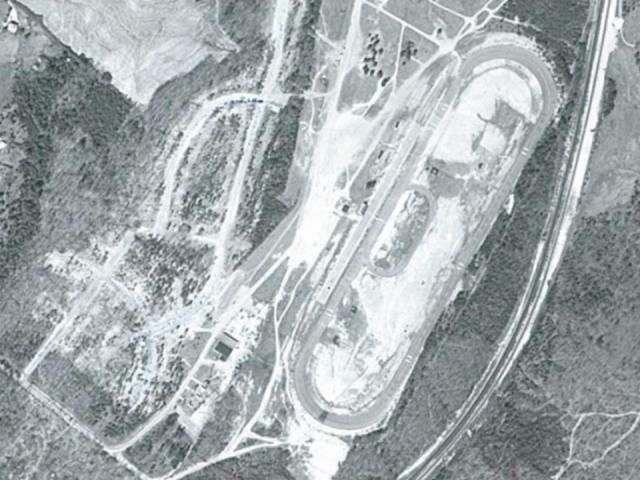
The track was a 1-mile paved oval. In fact, it was one of the longest paved ovals in the country by that time. The track featured long, flat straightaways and tight corners. It was shaped like a paperclip, almost like Martinsville. Only it was twice as long, and the corners had sixteen degrees of banking. The track was so tight that only 500 feet separated the front and backstretch in the infield. Meanwhile, the straightaways were measured to be around 1,850 feet in length.
There were a number of different series that took to the track. Most popularly were the IndyCar series and the NASCAR Grand National division. Lower-ranked series also competed at the track, though. Local racers competed weekly on the quarter-mile in-field oval and NASCAR’s Modified division also regularly raced at the track. In was in the NASCAR Modified rank when the biggest tragedy in the track’s history struck.
There have been only two fatalities in the history of the race track, both coming during a modified race on September 19, 1953. The incident involved drivers Bill Blevins and Jesse Midkiff. Bill France himself was driving the pace car for the event. Blevins was suffering some mechanical issues and his car had stalled on the backstretch. France didn’t get the memo and exited the track as the field prepared to take the green. Nobody could have seen what happened next. The leaders were able to serve and miss Blevins but, lost in traffic, Midkiff didn’t see the stalled car. He plowed into him at full speed, causing an eruption of flames. Blevins died on impact. Midkiff days later from severe burns suffered in the incident.
This kind of incident was commonplace for the time. Though it did spark controversy amongst the locals who didn’t want the track to exist in the first place. NASCAR Modifieds and Strictly Stocks continued to race at the track until 1958.
There have been a few big names to win at the forgotten speedway of Raleigh Speedway. Surprisingly, none of them were named Petty. Fonty Flock has two wins at the track, those coming in 1953 and 1955. Herb Thomas won back-to-back races in ’54 and ’55. Paul Goodsmith won the at the track in 1957. But it was Fireball Roberts who claimed the victory at the final race at the track. That came in 1958. He also won there two years prior in ’56.

Following the track’s closure in 1959, the track sat abandoned for eight years. Southland Speedway, aka Raleigh Speedway, was demolished in 1967. Today, it is the home of the Seaboard Industrial Park. Running parallel to it, where the frontstretch used to be, is the Seaboard Coastline Railroad. Some of the actual pavement of the track does still exist, though. In the wooded area of the industrial park, there’s about 90 feet of busted asphalt. That’s all that remains of the original Raleigh Speedway.
However, racing did return to the Wake County/Raleigh area in the following decades. In 1962, the Wake County Speedway was built about five miles from the original site of the track. It’s a NASCAR-sanctioned quarter-mile oval.
So, Daily Downforce readers, what did you think of this one? Do you wish that Raleigh Speedway was still around? Or is it better off left in the past? Let us know your thoughts on this! Join the discussion on Discord or X, and remember to follow us on Instagram, Facebook, and YouTube for more updates.
Up next in this Forgotten Speedways series: Walt Disney World Speedway.