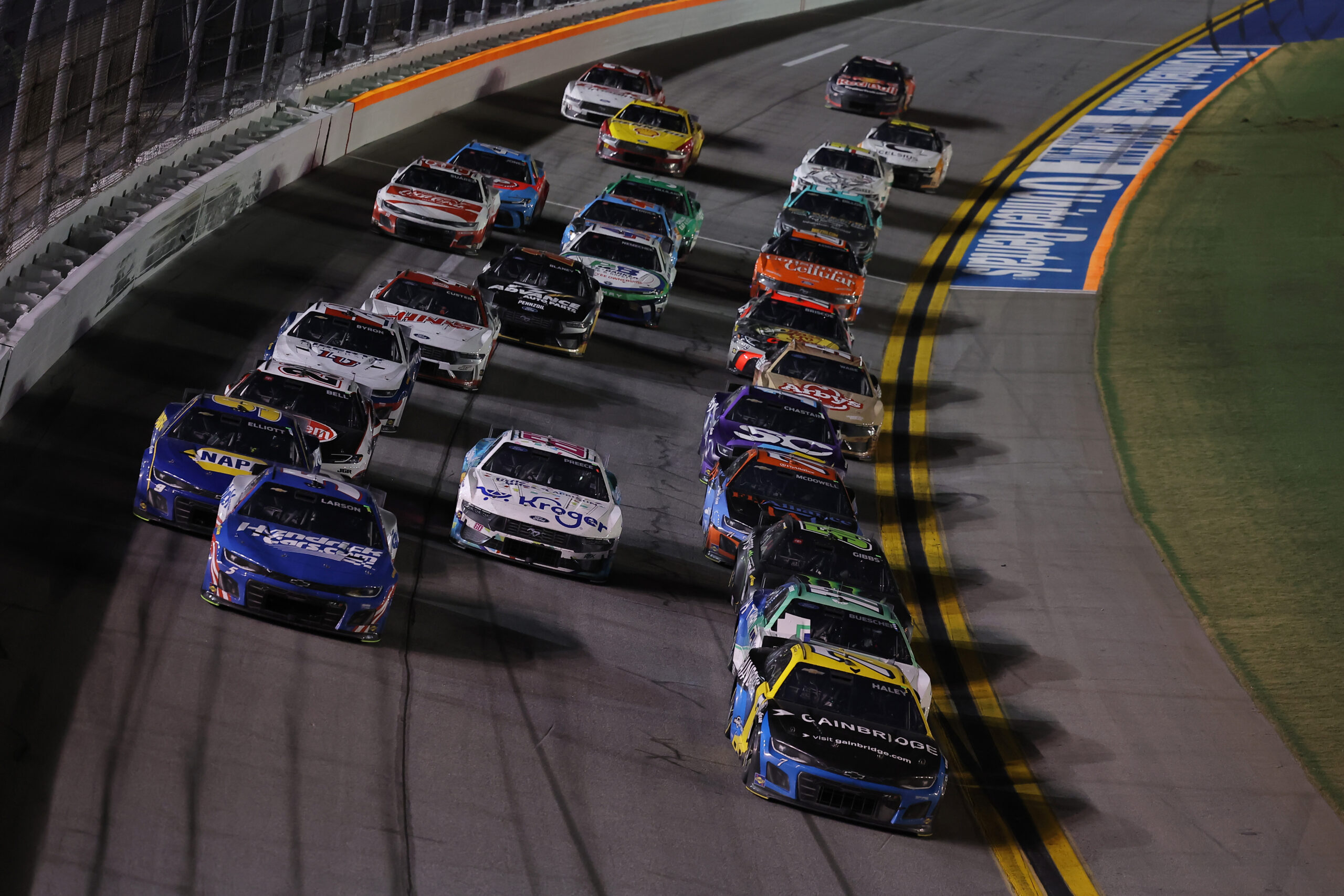
Will NASCAR Add a Fourth Stage to Daytona and Talladega?
What’s Happening? NASCAR’s Mike Forde confirms that in response to fans’ complaints about fuel saving during superspeedway races, NASCAR has discussed…
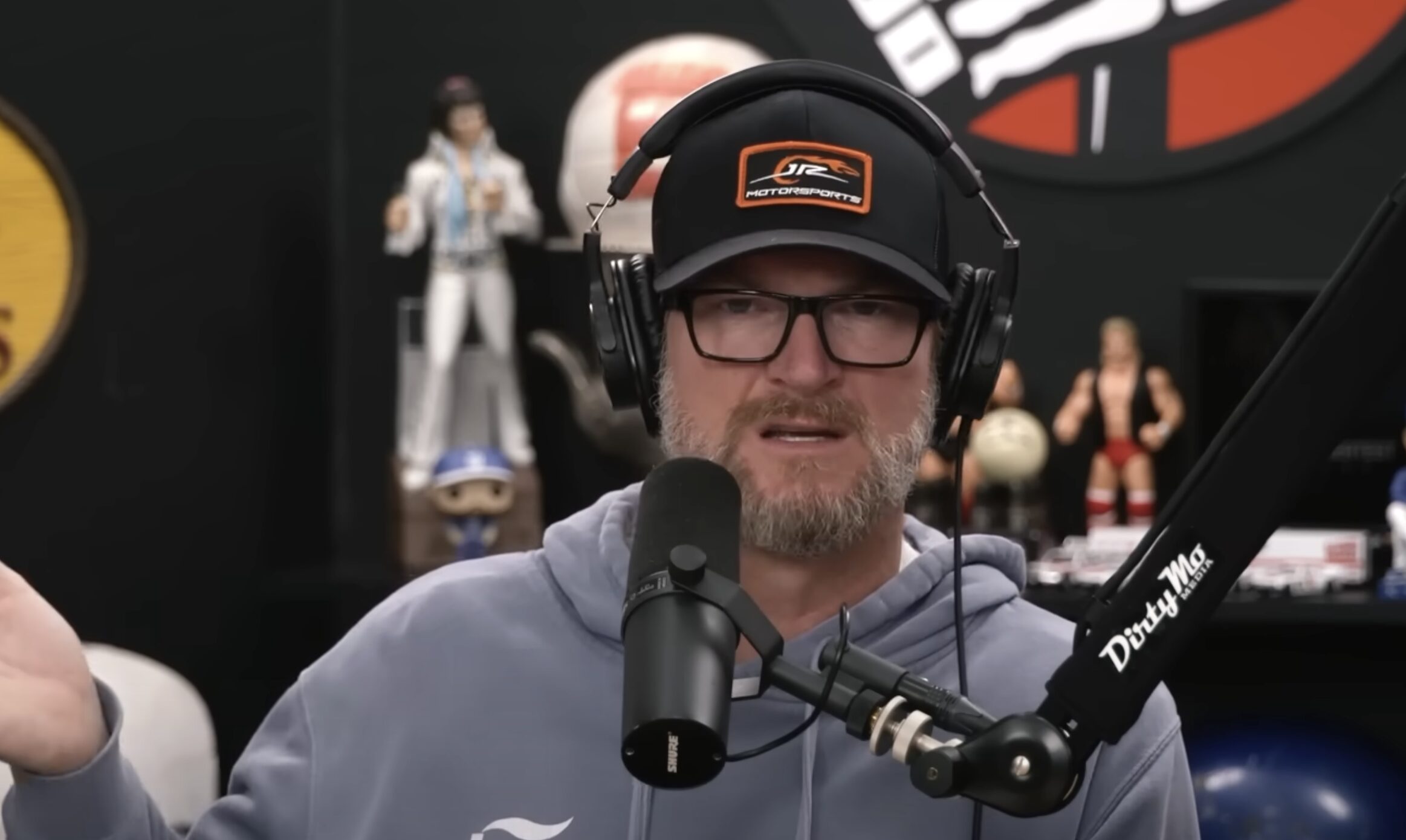


During the latest episode of the Dale Jr Download, NASCAR legend Dale Earnhardt Jr addressed recent talks that NASCAR could add a fourth stage to superspeedway races, calling an additional stage a “nothing burger.”
Though there is still some time before the NASCAR Cup Series returns to a superspeedway, the conversation surrounding the aggressive fuel-saving strategies of teams remains a hot-button issue.
During these races, to maintain track position, teams find themselves doing everything they can to save fuel and, in turn, save time on pit road during green flag pit stops. This strategy, though effective, can lead to slow on-track speeds in the already gridlocked field.
This conversation has reignited thanks to comments from NASCAR’s Managing Director of Communications, Mike Forde, during last week’s episode of NASCAR’s in-house podcast Hauler Talk. During that episode, Forde said NASCAR officials have discussed, but not in a serious manner, adding a fourth stage to races on Superspeedways.
What’s Happening? NASCAR’s Mike Forde confirms that in response to fans’ complaints about fuel saving during superspeedway races, NASCAR has discussed…
Though the idea of this change received pushback from fans online, it is a solution that is often suggested to terminate the fuel-saving strategy from these races. One supporter of this idea is NASCAR Hall of Famer and superspeedway ace Dale Earnhardt Jr, who spoke on Ford’s comments during the latest episode of The Dale Jr Download.
Earnhardt had suggested the idea of adding a fourth stage to races in recent episodes, but responded to the backlash from fans during Tuesday’s edition, standing by his support for adding a fourth stage, saying, “Is it the best solution? No. Is it the the perfect solution? It is not.”
In Earnhardt’s opinion, if NASCAR adds a fourth stage, spaced out to eliminate any potential green flag stops in the early portion of the race, it will create the on-track action fans want to see. “If you say, ‘Hey, we’re gonna have 40 laps, you don’t need fuel, race your ass off,'” Earnhardt said. “I think you’re gonna have more action.”
The Hall of Famer also clarified that he understands people are not fans of the idea of the fourth stage, but, in his eyes, it’s a “nothing burger,” comparing the idea to the only race that currently has a fourth stage, the Coca-Cola 600.
“I know that everyone doesn’t love this idea of the fourth stage, but I’m telling you, it’s a nothing burger because we don’t look at the 600 and go, ‘ah damn, that fourth stage.’ Nobody even cares. . . I don’t think anybody even picks up on the idea that it’s even in there. You know what I mean?” — Dale Earnhardt Jr.
While Earnhardt suggests that it could be overlooked, the way some overlook, and maybe even forget, the Coca-Cola 600 has four stages, even the idea of adding a fourth stage at Daytona and Talladega has fans up in arms.
While the concept of stage racing is still relatively new to a sport that is over 70 years old, the debate surrounding adding a fourth stage is a heated one, with fans suggesting their own solutions to fixing the current state of superspeedway racing in NASCAR.
Of course, some fans are quick to say ‘fix the car,’ pointing to the passing issues that the NASCAR Next Gen car has on superspeedways, though this take is often spammed whenever conversations around the quality of racing come to the forefront.
The main opposition to the addition of the fourth stage is those who suggest getting rid of the stage breaks and still awarding points, something NASCAR did at road courses in 2023, though they reversed course shortly after. The idea behind this is that teams will be less inclined to save fuel with the subtraction of those two-stage cautions.
Earnhardt pushes back at this idea, saying that he does not think that is on the table for NASCAR, though “I would try to use whatever influence we have here to support that.”
But, even though he says he would support that if it were on the table, it’s clear that he thinks this is not the solution that will fix the fuel-saving problem, saying:
“If you take the cautions away from the stage breaks themselves, take them out, you’re still gonna have guys that are gonna sit in the draft, save, save, save, save, save, to knock a couple seconds off of that final stop and leapfrog the field.” — Dale Earnhardt Jr.
Nonetheless, NASCAR has yet to announce the addition of fourth stages to superspeedways for October’s race at Talladega or the four races at Daytona and Talladega in 2026, as, once again, Forde said during Hauler Talk, these discussions were not “seriously discussed.”
What do you think about this? Let us know your opinion on Discord or X. Don’t forget that you can also follow us on Instagram, Facebook, and YouTube.