
Denny Hamlin believes Bubba Wallace made the right decision by going for the race win at EchoPark Speedway, even if it ultimately resulted in one of the more debated penalties of the 2026 NASCAR Cup Series season.
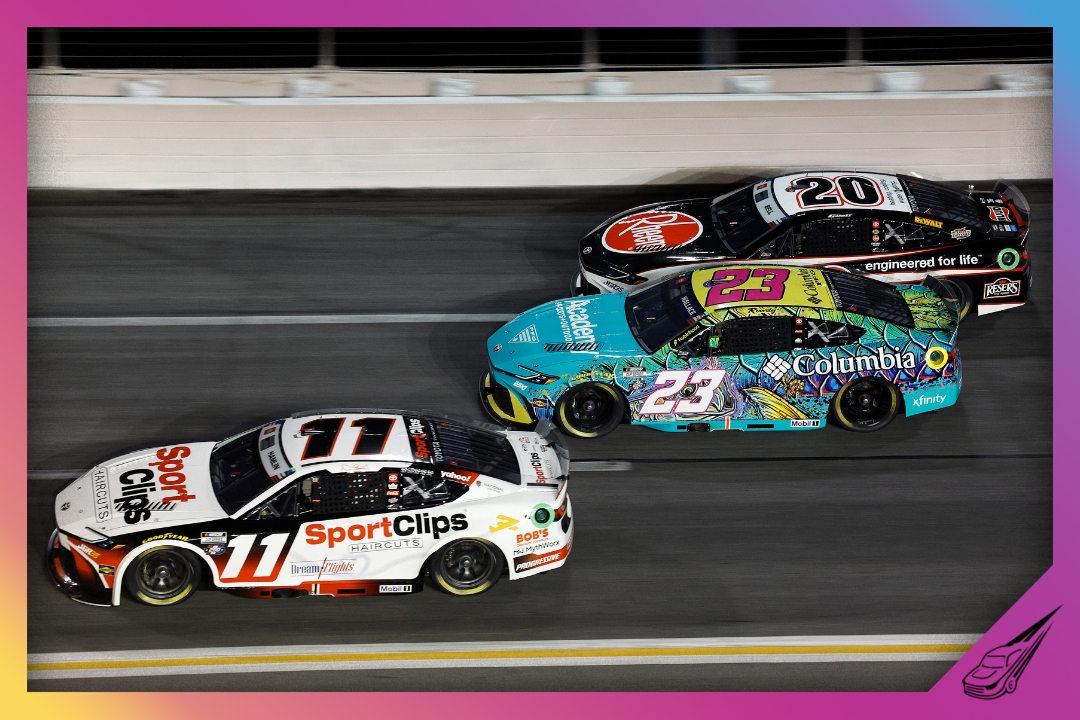
At the EchoPark Speedway race this past weekend, Bubba Wallace entered the final lap running third behind Ryan Blaney and Carson Hocevar. As Blaney pulled alongside Hocevar entering Turn 1, the No. 23 driver spotted a narrow opening on the inside and immediately committed to making it three-wide.
Speaking on his Actions Detrimental podcast, 23XI Racing team owner Denny Hamlin explained that Wallace’s move wasn’t a case of poor judgment but the only realistic opportunity he had to steal the victory on the final lap.
Hamlin said that was exactly what Wallace needed to do if he wanted any chance of reaching Victory Lane, even if it did result in a penalty for crossing below the double-yellow line.
“It was the only percentage shot he had of winning is to get three wide, and hopefully get a push, and it just, I mean, he just barely crossed over there,” Hamlin said.
While he agreed that such a move would have been much easier at a wider drafting track like Talladega, EchoPark Speedway simply doesn’t provide drivers with the same amount of racing room.
Hamlin further pointed out that Carson Hocevar’s car appeared to make a slight move toward the bottom of the racetrack before leaving space. That subtle movement, along with Wallace’s closing speed, made it extremely difficult for the No. 23 Toyota to stay entirely above the double-yellow line once he committed to the inside.
“If you look, the 77 makes a little bit of a a stutter-step type of, like ‘Let me show you, I’m gonna block low’, even though the 77 left room. With the momentum and the speed that the 23 was coming around, it would have been hard for him to control his car within the limits. Because of how quick he turned left there.”
In the JGR driver’s view, Wallace only “barely” crossed below the line, but by then the move had already been set in motion.
While Hamlin defended Wallace’s decision-making, he also explained why drivers frequently find themselves in this situation.
From inside a Cup car, the double-yellow line is nowhere near as visible as it appears on television. EchoPark Speedway’s apron and racing surface have very similar banking, making the transition difficult to distinguish at nearly 190 mph.
“When I’m going on the backstretch at Atlanta, the difference between the apron and the actual racetrack, there’s not much difference in banking. So looking at a straight line is like looking at a landing strip for an airplane. It’s just dead flat, and you don’t see where the other stuff is.”
“It is a wall. That’s how they rule it,” Hamlin added when prompted if the double-yellow line feels like an invisible wall from inside the car. While officials enforce the boundary as though it were a physical barrier, drivers often cannot accurately judge its location until they are fully committed to the move.
Although Hamlin sympathized with Wallace’s situation, he ultimately defended NASCAR’s decision to issue the penalty. In his opinion, the sanctioning body simply enforced the rule exactly as it is written.
“When I watched it, I was thinking that that’s definitely gonna be a penalty, because I’ve been penalized for it before.” — Denny Hamlin
The NASCAR Rule Book states that advancing position below the double-yellow line results in a penalty, and once officials determined Wallace had violated that rule, they had little choice but to apply it.
The incident changed the post-race points picture in a big way, as Wallace initially crossed the finish line having secured second place behind Blaney.
However, NASCAR penalized the No. 23 Toyota for violating Section 8.7.2.A of the Rule Book, dropping Wallace to 29th, the final car on the lead lap. The decision alone cost him 27 championship points.
Wallace strongly disagreed with NASCAR’s interpretation. After the race, he reviewed telemetry and video alongside crew chief Charles Denike and 23XI Racing competition director Dave Rogers before meeting with NASCAR officials.
Despite Wallace’s disagreement, NASCAR upheld the penalty.
The setback was even more painful because Wallace had spent much of the evening racing near the front, leading 11 laps and consistently battling among the leaders.
Earlier in the race, contact from Ty Gibbs at the end of Stage 2 had already cost him valuable stage points. Combined with the post-race penalty, Wallace left EchoPark Speedway with only nine championship points, despite having one of the fastest cars in the field.
Although he remains 13th in the Cup Series standings, he surrendered 22 points relative to the Chase cutline in a single afternoon. Wallace admitted afterward that the team chasing him in the standings would see the points loss as a major opportunity, acknowledging that his Chase position is far from secure.
What do you think about this? Let us know your opinion on Discord or X. Don’t forget that you can also follow us on Instagram, Facebook, and YouTube.