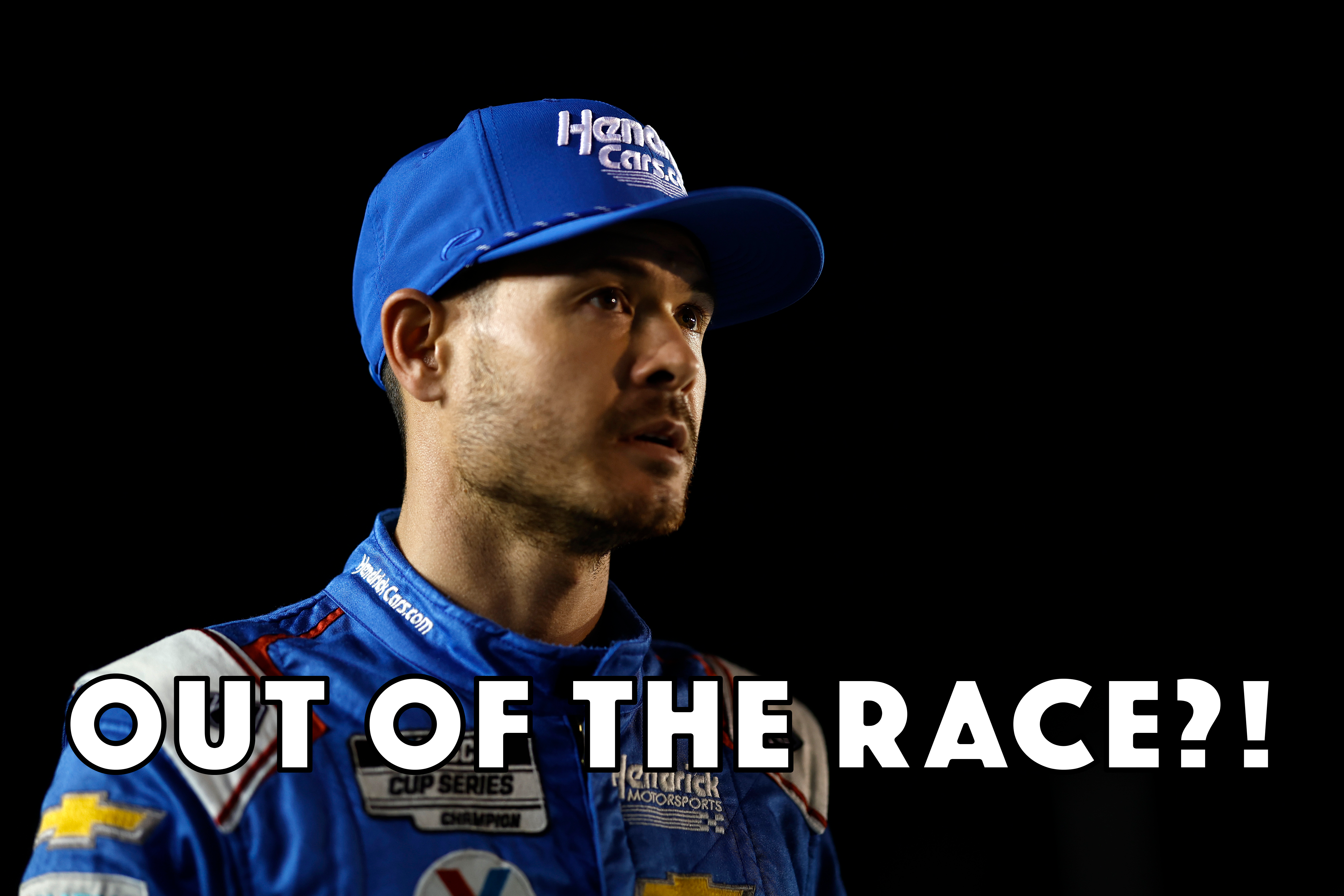

Kyle Larson’s Memorial Day “Double” hit a snag. A violent thunderstorm delayed the Indianapolis 500 until this afternoon, meaning a tough decision was made. Kyle Larson will miss the start of the Coca-Cola 600, casting doubt about his potential eligibility for the Cup Series Playoffs. Here’s everything you need to know.
After a long rain delay, Indianapolis Motor Speedway announced that the 2024 Indianapolis 500 will start at approximately 4:44 PM ET, roughly 4 hours after its’ original scheduled start time. Soon afterwards, it was announced that Larson would start the Indianapolis 500.
Kyle Larson is STAYING to run the #Indy500, and just listen to his engine come alive!
— INDYCAR on NBC (@IndyCaronNBC) May 26, 2024
📺: NBC and Peacock pic.twitter.com/x3EaWxFzuD
Larson will miss the start of the Coca-Cola 600, and Justin Allgaier will start the race in the No. 5 car. Jordan Bianchi reports that Allgaier said that Larson would get in the car no matter when he showed up.
. @bobpockrass and I spoke to Justin Allgaier. Allgaier told us that whether Kyle Larson were to arrive "on Lap or with 10 (laps) to go," Larson would get in the No. 5 Hendrick car to finish the Coca-Cola 600.
— Jordan Bianchi (@Jordan_Bianchi) May 26, 2024
If Larson doesn’t start the Coca-Cola 600, he would be deemed ineligible for the NASCAR Cup Series Playoffs unless he is granted a waiver from NASCAR. Waivers had previously been granted to drivers who intended to run the full season but were unable to due to other factors like injuries or suspensions. However, Larson’s case is a new one. Jeff Gluck reports that Larson will “almost certainly” get a waiver.
You probably already figured this out, but Kyle Larson will stay and run the #Indy500 today. He will miss the start of the Coke 600 and need a playoff waiver from NASCAR (which he will almost certainly get). Rules say drivers must start every race “unless authorized by NASCAR.”
— Jeff Gluck (@jeff_gluck) May 26, 2024
The Indianapolis 500 is officially on a weather delay. While no official start time has been announced, the current ballpark prediction is around 4:30 PM ET. Should the Coca-Cola 600 run on time, Larson would not be able to complete both the Indy 500 and the Coca-Cola 600.
IndyCar is targeting a green flag for the 2024 Indianapolis 500 around 4:30-5:00 PM ET.
— Austin Konenski (@AustinKonenski) May 26, 2024
Kyle Larson and Hendrick Motorsports are going to be forced into a decision.
Indianapolis 500 or Coca-Cola 600?
In the wake of the weather delay, Kyle Larson gave his thoughts to NBC reporter Marty Smith. Larson said, “I think our plan is to keep this the priority”. However, Larson later acknowledged that this is a collaborative decision.
"I think our plan is to keep this the priority."@KyleLarsonRacin discusses his plans for The Double if inclement weather affects the start of today's race.
— NTT INDYCAR SERIES (@IndyCar) May 26, 2024
📺: #Indy500 on NBC and Peacock pic.twitter.com/em0uURdkkS
It’s not just my decision. I think it’s everybody within Hendrick, Rick Hendrick, Hendrick Automotive Group, Hendrick Motorsports, all of that, you know, I think we’re all a part of the decision, Jeff Gordon, Jeff Andrews. There’s just been so much time and investiment in this, to make this Indy 500 happen. It’s been a buildup for over a year, so, we need to run it, and I want to. I feel like I have a good shot to have a good run and potentially win. I want to be here, but ,I just wish it would all work out and we could get both races in the full distance. I don’t care if it’s on the same day.
Kyle Larson
One of the people Larson mentioned, Jeff Gordon, also gave his thoughts on the move. According to this tweet from Danielle Trotta, Gordon says that the plan is to get Larson to Charlotte at some point, but, what that point is, is currently uncertain.
Jeff Gordon on NBC just now: We have every intention of getting Kyle Larson to Charlotte. We are gonna do everything we can to watch weather and play logistics game but even if we run Indy we wanna get him to Charlotte.
— Danielle Trotta (@DanielleTrotta) May 26, 2024
Larson’s issue is that if he chooses to skip the Coca-Cola 600, he would need a waiver to qualify for the Playoffs. He qualified for the Coca-Cola 600, and if he enters later in the race, maybe NASCAR will give him a waiver. Justin Allgaier is Larson’s backup driver at Charlotte.
However, the weather in Charlotte is very uncertain as well. Local meteorologist Brad Panovich pointed out that weather could hit Charlotte Motor Speedway this evening, likely at about 8-9 PM or about halfway through the race, putting the Coca-Cola 600 in jeopardy.
The #Coke600 should start on time, but storms will threaten during the race, possibly as early as 7pm, but more likely 8-9pm. #nascar #cltwx pic.twitter.com/r257BeVGWi
— Brad Panovich (@wxbrad) May 26, 2024
If the Coca-Cola 600 is delayed, Larson could complete both races. If both races are postponed, “The Double” could also be a Monday affair.
Jenna Fryer also reported last year that Larson’s deal with McLaren is two years. A 2025 “Double” run also seems like it can happen.
Nugget I’ve uncovered: The Kyle Larson-Hendrick-McLaren-Indy 500 deal is a 2-year deal for 2024 and 2025. He’s expected to test this year.
— Jenna Fryer (@JennaFryer) February 27, 2023
Stay tuned to The Daily Downforce as we keep you updated on everything regarding this story.